Digital Fascism and Digital Capitalism
Christian Fuchs
Paderborn
University, Paderborn, Germany,
https://fuchsc.net, christian.fuchs@triple-c.at
Abstract: What is digital fascism?
What is digital capitalism? How are they related? This article theorises
digital fascism as a contemporary form of right-wing authoritarianism rooted in
capitalism and reorganised through digital infrastructures. Building on the Frankfurt
School’s analysis of authoritarianism, it reconceptualises fascism as a
terroristic, anti-democratic mode of organisation – leadership cults,
nationalism, friend/enemy polarisation, and militant patriarchy – whose
resurgence is catalysed by capitalist crises. The paper advances a dual
framework: fascist practices (cognition, communication, co-production) and
digital structures (platforms, algorithms, datafication) recursively produce
one another – the tripleC dynamic – enabling user-generated hate, post-truth
propaganda, algorithmic targeting, cyberattacks, and digitally mediated
violence. Ten historical hypotheses map shifts from broadcast propaganda to
influencer networks, from street militias to partially automated conflict, and
from overt anti-democracy to “creeping” authoritarianism that claims democratic
legitimacy. Integrating political-economy evidence, the article demonstrates
how key fractions of digital, financial, and fossil/transport capital fund and
legitimise emergent authoritarian projects, crystallising an authoritarian
digital capitalism whose boundary with digital fascism is porous. The
conclusion argues for a digital democracy that counters the fusion of big
business and big power in the digital age.
Keywords: fascism, capitalism, digital fascism, digital capitalism
Acknowledgement: This paper was first published in the journal Philosophy & Social Criticism. Using a CC-BY license, the original article has been reproduced in tripleC: https://doi.org/10.1177/01914537261434922
On 21 January 2025, some of the world’s most powerful digital tech moguls were guests at Donald Trump’s 2025 US presidential inauguration. They included Elon Musk (X), Mark Zuckerberg (Meta), Jeff Bezos (Amazon), Sundar Pichai (Alphabet), Tim Cook (Apple), Shou Zi Chew (TikTok USA), and Sergey Brin (Google/Alphabet)[1]. These people are not just representatives of the most powerful digital media corporations; some of them are also among the richest people in the world[2]. Some observers interpreted this visibility as a symbolic link between digital capital and the new administration’s nationalist rhetoric.
In this context, notions such as digital authoritarianism (Gosztonyi 2023, Maerz 2024, Pearson 2024, Roberts and Oosterom 2024) and digital fascism (Degeling 2024, Demír 2025, Fielitz and Marcks 2019, 2022; Fuchs 2022; Klikauer and Simms 2021) have been used. In order to analyse contemporary transformations of capitalism and society, we require good definitions and understandings of such terms. This paper aims to contribute to theorising fascism and digital fascism by dealing with the following two questions: What is digital fascism? How are digital fascism and digital capitalism related?
I argue that, first, “digital fascism” is
best understood as a duality of practices and infrastructures – fascist
cognition, communication, and co-production recursively shaped by platform
architectures and data economies; second, that contemporary “digital
capitalism” supplies the incentives, funding, and affordances that make such
practices more likely and more scalable. The paper proceeds in the following
manner. First, it discusses the notion of fascism (section 2), then it moves on
to the features of digital media (section 3), theorises digital fascism
(section 4), and outlines the relationship of digital capitalism and digital
fascism (section 5). Finally, some conclusions are drawn.
If we want to understand what digital
fascism is all about, we first need an understanding of fascism, which is why
it makes sense to first engage with often-cited definitions of fascism.
In contemporary
understandings of fascism, there are some frequently cited definitions: One is
Roger Griffin’s (1993, 2003) concept of fascism as palingenetic
ultranationalism that features nationalism, racism, and anti-liberalism.
Stanley G. Payne (1995, 14) provides a similar understanding that sees fascism
as “revolutionary ultranationalism for national rebirth“. Jason Stanley defines fascism as a
radical form of nationalism: “At the core of fascism is
loyalty to tribe, ethnic identity, religion, tradition, or, in a word,
nation. But, in stark contrast to a version of nationalism with equality
as its goal, fascist nationalism is a repudiation of the liberal democratic
ideal; it is nationalism in the service of domination, with the goal of
preserving, maintaining, or gaining a position at the top of a hierarchy of
power and status“ (Stanley 2018, 97). Eatwell (1996) defines a fascist minimum
where charismatic leadership, collectivism, nationalism, violence,
anti-liberalism, and a third way beyond socialism and capitalism are the key
features of fascism. Paxton (2004, 218) describes fascism as “a form of political behavior marked by
obsessive preoccupation with community decline, humiliation, or victimhood and
by compensatory cults of unity, energy, and purity, in which a mass-based party
of committed nationalist militants, working in uneasy but effective
collaboration with traditional elites, abandons democratic liberties and
pursues with redemptive violence and without ethical or legal restraints goals
of internal cleansing and external expansion”. Many
contemporary updated analyses of fascism base their understanding of fascism on
such definitions (for example, Bratich 2022; Fielitz and Marcks 2022, 2019), which illustrates their
influence.
The definitions by Griffin, Payne, and Stanley focus on nationalism. Eatwell and Paxton analyse fascism as a form of politics that has a number of listed features. All of these definitions are politically focused: They have a strong focus on political theory and foreground fascism’s political dimension. Although politics is an important dimension of fascism and society, it is always integrated with the economy, which is what political economy approaches stress (see Wolff and Resnick 2012; Caporaso and Levine 1992). The cited definitions lack a focus on the economy and the interaction of the economy and politics. They cannot explain why fascist movements often intensify in times of heavy political-economic and social crises and why there has been a close connection between capitalist interests and fascist politics. They do not explain “why fascist movements, however great their rhetorical anti-conservatism, always relied on conservative forces”, that is, forces that want to preserve capitalism and naturalise inequalities, “to gain support and aim at power – never on those of the left” (Thompson 2011, 88). They do not take seriously Max Horkheimer’s (1939/1989, 78) note that “whoever is not willing to talk about capitalism should also keep quiet about fascism”. Given that today Silicon Valley as capital’s hegemonic faction supports authoritarianism, we, just like at the time of Horkheimer, also today need a focus on the analysis of the interconnection of (digital) capitalism and (digital) fascism.
My understanding of fascism takes a different starting point, namely the
Frankfurt School’s notion of authoritarianism. In contrast to the approaches
mentioned above, it does not ignore but takes capitalism seriously. The
starting point of thinkers such as Wilhelm Reich, Erich Fromm, Theodor W.
Adorno, Max Horkheimer, and Herbert Marcuse in their analyses of German
Nazi-fascism was the question of why, in the crisis of capitalism following the
Wall Street crash of 1929, many workers did not resist Hitler but turned
towards fascism. The connection of fascism and capitalism was the context of
their thought and analyses.
Wilhelm Reich, whose book The Mass Psychology of Fascism was a precursor to the Frankfurt School’s analysis of fascism, argued that fascist ideology embeds the “economic process [of capitalism] in the psychic structures of the people who make up the society” (Reich 1933/1972, 18). He argued for an interdisciplinary approach to fascist studies that combines critical political economy, ideology critique, and critical psychology.
Building on and going beyond Reich, the
Frankfurt School’s starting point in the analysis of fascism was the notion of
the authoritarian personality, a category that they used for combining
psychology, political economy, and social theory. From 1929 until 1931, Erich Fromm conducted a survey
among German workers in order to find out how they thought politically. He
obtained 584 responses. In his study, which was later published under the title
The Working Class in Weimar Germany
(Fromm 1984), Fromm distinguished between the radical,
the authoritarian, and the compromise-oriented personality. In 1936, the
Frankfurt School published a study of authority and family. The goal was to
understand where and how fascism originated (Horkheimer 1936/1987). The volume
featured theoretical foundations written by Max Horkheimer, Erich Fromm, and
Herbert Marcuse, as well as empirical research, case studies, and literature
reports by various authors. In his chapter on socio-psychological foundations
of authority, Fromm defined the authoritarian personality as an individual who “exercises
aggression against the defenseless and sympathy with the powerful“ (Fromm
1936/2020, 24). In the study’s general part,
Max Horkheimer (1936/1972, 70) defines authority as “internal and external behaviors in which
men submit to an external source of command”[3]. The members of
the Frankfurt School fled from Hitler to the USA. In the USA, Adorno, together
with others, conducted an empirical study of the authoritarian personality
(Adorno et al. 1950). Fromm wrote a book on the authoritarian personality. Its
title was Escape from Freedom (Fromm 1941/1969). In his book Behemoth,
using Nazi-Germany as a case study, Franz L. Neumann (1944/2009) elaborated a
theory of fascism that integrated the analysis of fascist ideology and
authoritarian ideology with political economy.
In their study The Authoritarian Personality, Adorno et al. (1950) tried to measure the authoritarian personality and how fascist individuals’ worldviews are. For doing so, they developed a questionnaire, the F scale (fascism scale). Four versions of this indicator were created, one with 78 questions, one with 60, one with 45, and one with 40. The questions were ordered along nine dimensions: 1. conventionalism; 2. authoritarian submission; 3. authoritarian aggression; 4. anti-intraception (rejection of subjectivity, fantasy, etc.); 5. superstition and stereotypy; 6. power and toughness; 7. destructiveness and cynicism; 8. projectivity (projection of fears to the outer world); 9. exaggerated concerns with sex. The F-scale questionnaire is fairly large and partly redundant. Based on it, I identified core themes of authoritarianism and created a model of authoritarianism (first introduced in Fuchs 2018b). The main advantage of this model is that it is not limited to a single level of organisation, but ranges from the micro-level (the individual, the group) to the meso-level (social movements, parties, social systems, institutions) and the macro-level (society as a whole).
One advantage of
the notion of authoritarianism for societal analysis is its scalability.
Authoritarianism and fascism are not organised at single levels, but take place
at encapsulated levels where each level presupposes and goes beyond the
underlying level: the individual, the group, social movements/parties, social
systems/Institutions, society. My approach does not restrict authoritarianism
to authoritarian individuals, authoritarian leaders, authoritarian parties, or
any other single level, but argues that authoritarian social movements and
parties are based on authoritarian individuals, that authoritarian institutions
presuppose authoritarian movements, and that an authoritarian society is based
on and goes beyond authoritarian institutions. There are emergent
organisational levels of authoritarianism. One level can, but does not
necessarily have to lead to a higher level that sublates (aufheben) the
lower level.
Authoritarianism
has originated as a concept for the analysis of a particular form of
consciousness and personality, the authoritarian personality, and has been
extended to the analysis of authoritarian groups, movements, organisations,
institutions, and societies. This means that authoritarianism is a multilevel
concept that ranges from society’s micro-level of society, through the
meso-level, up to the macro-level.
Although we can nowadays sometimes hear that we live in a world beyond left and right (Giddens 1994), the political theorist Norberto Bobbio argues that such a political distinction remains significant. Left- and right-wing worldviews start from different presuppositions: On the political left, there are “people who believe that human beings are more equal than unequal“, while the political right is made up of “people who believe that we are more unequal than equal“ (Bobbio 1996, 67). The “egalitarian condemns social inequality in the name of natural equality, and the anti-egalitarian condemns social equality in the name of natural inequality“ (68-69). Given that right-wingers assume that humans are fundamentally unequal, they tend to favour discrimination and unequal treatment, while left-wingers tend to favour equal treatment and to oppose discrimination.
Those on the right spectrum of politics share the assumption that inequality is natural and humans are, by (social) nature, unequal. There are, however, different versions of right-wing ideology, ranging from conservatism on one end to fascism on the other. Right-wing extremism is a form of right-wing ideology situated in-between conservatism and fascism. Conservatism can be understood as a version of right-wing authoritarianism that accepts the structure of democracy while applying authoritarian principles within it. Rather than endorsing terrorism, it promotes policies of law and order. Right-wing extremism, by contrast, is not itself a form of society but an ideology and political movement. We do not typically speak of a “right-wing extremist society”, but of “a right-wing extremist” and “a right-wing extremist movement/group/party”. Right-wing extremism tends to justify and support violence against imagined enemies, though its actions often remain confined to rhetoric, symbolism, style, and ideology. Fascism, however, functions at multiple levels – within individual consciousness, groups, organisations, institutions, and across society as a whole. It actively organises and institutionalises terror and violence as political tools, representing a genocidal form of right-wing authoritarianism that seeks to create a society built on systematic persecution and extermination of defined enemies. Fascism embeds leadership cults, nationalism, the friend/enemy distinction, and militant patriarchy into social order. It emerges as a reaction to the conflicts and crises within capitalist and class societies. Fascists rationally organise fears and anxieties that humans have as a result of structures of alienation. They try to mobilise those fearful of downward mobility with promises of a stronger society where the national community thrives by benefiting insiders and eradicating the enemies blamed for its problems. By scapegoating these constructed enemies and diverting attention away from systemic, structural causes, fascism plays an ideological role within class societies. It conceals the ties between capitalism and societal problems by substituting nationalism and enemy-making. Liberal theories of fascism often minimise or overlook the dual relationship between fascism and capitalism – fascism’s ideological function within capitalism and capitalism’s latent fascist potentials and tendencies. Orthodox leftist approaches frequently reduce fascism solely to an expression of capitalism, downplaying nationalism, racism, xenophobia, antisemitism, and exterminatory politics.
Table 1 provides
a comparative overview of some concepts that have been used for analysing
far-right leaders, movements, and societies.
|
Term |
Level of analysis |
Violence central? |
Relation to democracy |
Dominant mechanisms of control |
Example references |
|
Authoritarianism |
Micro → macro (personality to regime) |
Instrumental |
Restricts pluralism, accepts limited elections |
Leadership principle, hierarchy, scapegoating, patriarchy |
Adorno et al. (1950); Fromm (1941/1969) |
|
Autocracy |
Macro (political regime) |
Optional |
Eliminates pluralism; suppresses opposition |
One-party rule |
Croissant and Tomini (2024) |
|
Fascism |
All levels; full societal form |
Constitutive / glorified |
Anti-democratic, terroristic |
Violence, terror, nationalism |
Paxton 2004; Neumann 1944/2009 |
|
Populism |
Meso (movement / discourse) |
Typically rhetorical |
Claims to democratise representation |
“People vs elite” framing, affective communication |
Laclau (2005); Bobba (2021); Gerbaudo (2018; 2024) |
Table 1: Some categories used in the academic literature for characterising the far-right
The advantage of the notion of authoritarianism in comparison to the other concepts mentioned in table 1 (autocracy, fascism, populism) is that it is scalable from the micro- to the macro-level. In the next step of my argumentation, I will introduce my own model of authoritarianism.
a) Every social group, system, or society operates on four key dimensions:
b) organisational principles,
c) a shared identity and practices that connect individuals and give meaning to their lives,
d) ways of defining and managing relations with the outside world, and
e) methods for addressing and resolving problems.
These four features describe the internal organisation of a social system (a and b) and their relation to other social systems and society (c, d). The approach I utilise is not a systems theory but rather a critical social theory that I have worked out in other places (see, for example, Fuchs 2020), which is based on the dialectic of human practices and social structures as well as the dialectic of humans and social systems.
At all levels of social organisation (micro, meso, macro), advocates of authoritarianism emphasise and promote:
a) hierarchical, top-down authority and the leadership principle as the foundation of organisations,
b) nationalism as the basis of identity – defined by the belief that one biologically or culturally constructed nation is superior to others,
c) a worldview structured around a strict friend/enemy divide, framing the nation as locked in conflict with perceived threats such as immigrants, refugees, socialists, liberals, Marxists, or religious groups outside the dominant tradition – an outlook that often manifests as racism, xenophobia, anti-socialism, anti-liberalism, and anti-Semitism,
d) a militant patriarchy that glorifies the soldier as the model citizen, enforces patriarchal gender roles, relegating women to subordinate positions, and upholds violence (through policies of “law and order”, militarism, or terror) as the preferred means of dealing with conflict and societal challenges.
Together, these four elements define the core features of right-wing authoritarianism. These four dimensions are aspects that make up the core of the Frankfurt School’s concepts of authoritarianism, such as the authoritarian personality, the authoritarian society, and Adorno’s F-scale. Figure 1 illustrates this model.

Figure 1: A model of authoritarianism
Authoritarianism necessarily features leaders and top-down-hierarchies, which means it is anti-democratic; nationalism as a construction of fictive ethnicity as collective identity that distracts from class structures; the scapegoating of certain groups that are blamed for the ills of capitalism and class society; and the propagation of repression against these groups. This means that the four features in figure 1 are necessary features of authoritarianism.
In figure 1, the black arrows on top between individual, group, institution, and society show that these are emergent organisational levels of authoritarianism where each new level interacts with the underlying level. The dotted arrows show that the four dimensions of authoritarianism are not independent but interact with each other.
Right-wing authoritarianism reacts to crises in politics and the economy through ideologies that appeal to the psychology of those who feel excluded. Individuals experiencing insecurity and dissatisfaction often relate to both love and hate in conflicted ways. They search for a new sense of identity and hope, while also wanting outlets to channel their anger and aggression. Public figures such as Trump, through TruthSocial, X/Twitter and other forms of mass communication, institutionalise this anxiety by offering people a chance to embrace the nation and its leader with devotion while directing hostility toward scapegoats. Right-wing authoritarianism operates through psychological drives – negative fears, desires, emotions, instincts, and affects. It rarely relies on reasoned debate but instead employs post-truth political psychology and ideology. But right-wing authoritarianism is not irrational. It is a rational form of irrationality. Authoritarian leaders, movements, and parties instrumentalise and rationally organise human anxieties and fears and create hatred against scapegoats. They organise the fears of groups that their “prestige, income, or even […] existence” are threatened (Neumann 1957/2017, 626). Franz L. Neumann (1957/2017) argues in this context that fascist movements “institutionalize anxiety” (626) by three methods – “terror, propaganda, and, for the followers of the leader, the crime committed in common” (628). Neumann sees a connection between anxiety and fascist politics. Fascists aim at the creation of what Neumann terms persecutory anxiety, the persecution of scapegoats.
Eva von Redecker analyses fascism through the concept of phantom possession (Phantomeigentum). According to Redecker (2020), phantom possession is the “unrealistic fantasy that full sovereignty over living, acting, self-conscious beings could be achieved” and the “accumulation of entitlement” regarding “oppressed others” (35). “Phantom possession provides social protection on a symbolic level“ (53). Redecker argues that the two main forms of phantom possessions and fictitious property are race and gender, specifically whiteness and masculinity, which have their roots in slavery and patriarchy (49). In racist relations, white people supposedly control the "whereabouts and the humanity of Black people“ (52), while in patriarchy, men are able to dispose of women’s reproductive capacities, including the female body, domestic labour, and care work (46).
Redecker (2020) argues that the rise of neo-authoritarianism and neo-fascism as violent defence of phantom possession has been conditioned by “financialized capitalism”’s “assault on all the forms of material social protection” and is a “reaction to – an jealousy of – progressive identity politics” (55). In this context, certain groups are presented as “agents of the loss” and “thieves” of phantom possession (57). Redecker (2026) writes that “fascism is the liquidating defence of phantom property" (20). Fascism has to do with the "defence of phantom property" (20) and “self-defence against thieves” (17). The enemies are “those who attack quasi-property and who therefore deserve to be liquidated" (17). Phantom property is “decoupled from actual, material property" (17). Examples of defended phantom properties Redecker mentions include the nation, the family, combustion engines, the boiler room, children, the German language, and freedom of expression (17).
Redecker presents an important materialist argument, suggesting that capitalism attempts to extend the logic of private property so that many phenomena are or appear as private property, which can be individually controlled, disposed of, or destroyed. She argues that authoritarianism manipulates and fuels fears of loss. However, she places greater emphasis on racism and patriarchy rather than the economy when analysing the ideological framework of fascism and authoritarianism. In capitalism, money, capital, and commodities are fundamental. Many fears of loss in capitalist societies relate to economic structures, particularly the fear of losing monetary wealth, including wages, savings, job security, living standards, affordable housing, affordable groceries, and access to free public services. For instance, in the 2025 Living and Working in the EU Survey, 59 percent of low-income respondents say they cannot afford to keep their homes cool, 72 percent cannot afford a holiday, 68 percent cannot afford leisure activities, and 80 percent cannot afford new furniture. The ongoing cost-of-living crisis and inflation are major economic issues that evoke fears of loss. Redecker underestimates the significance of these economic factors. Patriarchy and racism, always have economic aspects, such as the gendered housework economy and racialised labour, but cannot be reduced to or derived from the economy. Not just phantom possession but also, and to a significant degree, economic property and commodity structures shape fascism and authoritarianism.
Authoritarian and fascist forces ideologically exploit human fears by creating scapegoats they blame for the real or imagined loss of property and possessions, including wealth/money, status/power, and identity/reputation. In capitalism, these resources are accumulated, forming social classes. As a result, fears of loss are fears of losing one’s position within existing structures. The ideological aspect of the friend/enemy scheme either involves the invention of societal problems (a problem is made up or exaggerated) or the invention of causes of societal problems (some group is blamed for causing certain actual societal problems). The phantom or imaginary element of possession in the friend/enemy-scheme is that ideologues seek to inflame fears of loss by fabricating problems or their origins. Marx (1867/2024, 49) argues that in commodity fetishism, social relations take on “the phantasmagoric form of a relation between things.” For Lukács (1971, 83), commodity fetishism leads to reification – the presentation of humans and society as things so that the “relation between people takes on the character of a thing and thus acquires ‘phantom objectivity’” that conceals “the relation between people”. Authoritarian and fascist ideologies operate fetishistically by concealing real societal relations and realities through the creation of scapegoats – phantom causes and illusory problems. They reify groups as scapegoats and attempt to deny their humanity by depicting them as worthless entities deserving denigration, marginalisation, and destruction. These scapegoats can include various groups, notably but not limited to racialised populations and women, as well as the poor, the unemployed, intellectuals, Jews, socialists, workers, and different social classes.
For Marx (1844, 281), alienation means “loss of the object to an alien power.” In capitalism, alienation is not confined to the economy but is, as David Harvey (2018) emphasises, universal alienation. Capitalism aims to make alienation universal so that poverty and wealth are “reciprocally determined” (Marx 1857/1858, 296), encompassing not only monetary poverty and wealth but also wealth and poverty in respect to power, status, reputation, identity. Fascism and authoritarianism exploit and fuel fears of alienation, which are always subjects’ fears of the loss of objects.
Alienation plays a dual role in the context of authoritarianism and fascism. Crises of capitalism and society deepen various forms of alienation, including objective human alienation from nature, the economy, the political system, culture, and society as a whole. In the friend/enemy scheme, ideologues attempt to evoke and mobilise fears of alienation, particularly its subjective aspect, feelings of alienation. Franz Neumann (1957/2017) argues in this context that authoritarianism seeks to link alienation to anxiety.
Marx (1844, 276-277) argues that alienation concerns the estrangement of humans a) from nature, b) from their life activity, that is, production and its products, c) from themselves (the body and the mind), and d) from other humans. Crises possess alienating features because they can a) as ecological crises disrupt the metabolism between society and nature, making life on Earth difficult or impossible; b) as economic and political crises, alienate humans from control over the fruits of their labour and political power to make a difference to society, c) as cultural and identity crises that shatter the reproduction and integrity of the human mind and body by denying humans recognition, health, and genuine knowledge; and d) as political and social crises that question the power and status needed to make a difference in society. Ecological crises lead to the loss of natural livelihood, economic crises to the loss of wealth, cultural crises to the loss of recognition and integrity, and political crises to the loss of power. In authoritarianism and fascism, natural, economic, political, and cultural resources serve both as a) factors in real crises that intensify alienation and increase the likelihood of fascism and authoritarianism and b) as fears of alienation fueled by ideologues. There is both the real and fictitious subsumption of alienation under fascism.
Fascism manifests across different layers of social life – the individual, the group, institutions, and society. Fascism at one layer does not necessarily produce fascism at the next, but higher levels presuppose the existence of fascism at lower ones. For instance, a fascist society depends on fascist individuals, groups, and institutions, but the whole is more than just their sum.
What role does violence play? What is violence? ”Violence is the intended, unintended, or threatened physical harm of a human being“ (Fuchs 2025, 14). “Violence is a form of power that is used to dominate others, to create fear and to shape their course of conduct. It is deployed and regulated by individuals, groups, and states. It is used by members of dominant groups against members of weaker social groups, as well as in response“ (Walby 2009, 198). Fascism’s central feature is that it favours, propagates, uses, and institutionalises violence as the main political means and organisational principle of society. Violence exists in many societies, including democratic societies, where the state defines a monopoly of the violence that is used under democratically defined conditions. The main difference between democracies and fascism is that in the first type of system, political debate and collective decision-making in the form of democratic institutions that include groups that hold different views predominate over violence, whereas fascism abolishes democratic debate, critique, political opposition and replaces democratic institutions with the institutionalisation of terror as the main political principle. In fascism, power “grows out of the barrel of a gun” (Arendt 1970, 37), while in a democracy, power grows out of the “generative force of communicative freedom” (Habermas 1996, 151).
Democracies try to settle political disputes by debate as a form of political communication in the public sphere, through elections, campaigns, peaceful protests, negotiations, strikes, and other non-violent means of political interaction. Therefore, fascism, as the institutionalisation of violence in the form of terror against political opponents and other scapegoats and war as a means of imperialist expansion, is inherently anti-democratic. “Fascism, which represents the most extreme right‑wing political and economic structure and ideology, is also the most virulent antidemocratic form of ethnocentrism. […] The politico-economic ideology of the fascists is consistently reactionary […] in being openly antidemocratic. The fascists show an explicit readiness to use force against labor, toward whom they reveal intense status-anxiety. They also display contempt for ideals of equality” (Adorno et al. 1950, 151, 840).
Based on these conceptual foundations, my understanding of fascism is as follows:
“We can define fascism as anti-democratic, anti-socialist and terrorist ideology, practice, and mode of organisation of groups, institutions and society that is based on the combination of a) the leadership principle, b) nationalism, c) the friend/enemy scheme and d) militant patriarchy (the idealisation of the soldier, the practice of patriarchy, the subordination of women, war, violence and terror as political means) and the use of terror against constructed enemies, aims at establishing a fascist society that is built on the use of terror and the institutionalisation of the four fascist principles in society, tries to mobilise individuals who fear the loss of property, status, power, reputation in light of the antagonisms as its supporters, and plays an ideological role in capitalist and class societies by blaming scapegoats for society’s ills and presenting society’s problems as an antagonism between the nation and foreigners and enemies of the nation so that fascism distracts attention from the systemic roles of class and capitalism in society’s problems and from the class contradiction between capital and labour. Fascism often propagates a one-dimensional, one-sided and personalising ‘anti-capitalism’ that constructs the nation as political fetish and an antagonism between the unity of a nation’s capital and labour on the one side and a particular form of capital or economy or production or community on the other side that is presented as destroying the nation’s economic, political and cultural survival” (Fuchs 2022, 316).
In this definition, the multi-level organisational character of fascism is reflected in the formulation that it is an “ideology, practice, and mode of organisation”. Note that political fetishism in this definition is based on but goes beyond Marx’s notion of commodity fetishism. For Marx, fetishism has to do with an ideological aesthetic of commodities that hides the social behind the thing character of money and commodities. In political fetishism, political categories such as the nation are reified and naturalised; they take on the character of things that veil the role of class relations in society. According to Daniel Woodley, fascism’s political fetish character means that it “seeks, through a mythology of unity and identity, to project a ‘common instinctual fate’ (uniform social status) between bourgeois and proletarianized groups, eliding the reality of social distinction in differentiated class societies” (Woodley 2010, 17).
Society’s three core subsystems are the economy, politics, and culture (Fuchs 2020, chapter 3). This means that a fascist society involves a fascist economy, a fascist political system, and a fascist culture. Via the economy, humans organise their relationship to nature. In all of these realms, humans utilise technologies for organising society, so technology is not a system, but a means used transversally throughout society. In the economy, humans socially produce use-values that satisfy human needs. In the political system, humans produce collectively binding decisions (decisions that are valid for all) that take on the form of rules or laws, which involves not just the formal political system (parliaments, the state, the government) but also the public sphere, including social movements, citizens, political debate, news media, etc. In culture, humans engage in practices through which they reproduce their minds and their bodies. In fascist societies, society’s subsystems take on a special form, namely dictatorial capitalism, the terrorist state, and propaganda culture (see table 2).
|
Realm |
Fascist
society |
|
Economy |
Dictatorial capitalism: Economic organisations
are organised in a dictatorial manner. Society is a class society.
Working-class organisations such as parties and trade unions are repressed.
Workers’ strikes are not tolerated and are outlawed. The economy and society
are capitalist in character. Fascist societies are
class societies where class is often denied by foregrounding that the nation
and nationalism unite all citizens and overcome divisions, while class
divisions persist. The capitalist economy tends to be dominated by large
private monopoly corporations or by a combination of private capitalist
monopolies and state capitalist monopolies. Scapegoats and
constructed enemies are often repressed or killed by labour (forced labour,
enslavement, labour camps, death by labour) or by other means. |
|
Politics |
The terrorist state: Politics is a
dictatorial one-party or one-person system that either openly opposes
democracy or calls itself democratic without being democratic. Capitalist and dominant
political and ideological interests are enforced politically with violence
and terror, which are the main means of politics. The political opposition is
repressed by ideological and/or violent means in order to render it powerless
or make it disappear. The public sphere is
controlled and censored so that protests, social movements, political
debates, civil society organisations, news and public opinion criticising the
regime are outlawed, repressed, or marginalised. There is no free media, no
freedom of speech and expression, and no freedom of the press. Minority rights, civic
rights, and human rights have little or no importance. Society is highly
militarised: a) There is law and
order politics, surveillance, and the use of repressive state apparatuses
(police, secret services, prison system) against the political opposition and
scapegoats. b) There is a strong
focus on military defence against foreign enemies in order to protect the
regime and potentially expand its borders by imperialist warfare. Warfare is
considered an important political means in international relations, which is
often preferred to diplomacy |
|
Culture |
Propaganda culture: Everyday life, private
life, education, entertainment, the media, sports, human-nature relations,
gender relations, voluntary and leisure organisations, and consumer culture
are highly ideologically and politically controlled so that they become means
of politics that constantly propagate the regime’s ideology, the cult of the
leader and/or the system, nationalism, militarism, hatred of scapegoats and
political enemies, etc. There is a triple-F-culture of fake news, fear, and
fanaticism. Ideology is constantly
produced and reproduced in order to sustain a culture of hate, which includes
hatred against certain groups, such as racism, xenophobia, anti-Semitism,
patriarchal ideology, and homophobia etc. |
Table 2: Fascist societies’ three realms
Having engaged with some foundations of the analysis of fascism, we will next deal with the question of what the core features of the digital are.
The intersection of military and economic interests has not exclusively, but to a significant degree, driven technological innovation. During the Second World War, the first true computers were built and used as machines for the encryption and decryption of messages (Williams 1997). Colossus was a computer system built in the UK in 1943-1944 that was used by the British Army for cracking the German army’s Lorenz cipher, which was used for encrypting military communication. First constructed in 1939-1940 by Alan Turing, Bombe was an electromechanical machine used for breaking the Nazis‘ Enigma ciphers. It had no memory and did not run general-purpose programmes; there was just one fixed decryption programme that was hardwired into the machine and could not be changed, so that it was not a software-programmable machine. That’s why one can see Bombe not as a computer but as a code-breaking machine. The origins of the Internet, as ARPANET, was closely related to the USA’s interest in creating secure communication networks in the context of the Cold War. A contemporary example of how the military-economic nexus drives technological development is the development of military drones in the context of the Ukraine war and the new cold war. These examples show that digital machines not only emerge in purely economic contexts, but also in the context of warfare, the military, and the connection between wars and the economy.
Digital media have two key features: 1) convergence and 2) prosumption (productive consumption). In electronic mass media technologies such as the radio and television, there were different technologies of production, distribution, and consumption. The computer is a convergence technology because digital hardware allows the convergence of different technologies in one digital technology just like different types of content are combined in digital content. This means that the computer is a convergence machine. Resources are produced, distributed, and consumed. Digital convergence in the context of production means that the production potentially blurs with the consumption of information (prosumption) so that consumers of information getting hold of digital means of production are enabled to produce information.
Marx pointed out the dialectic of production and consumption and used the notion of productive consumption. “Production as directly identical with consumption, and consumption as directly coincident with production, is termed by them productive consumption“ (Marx 1857/1858, 90). He argues that production consumes means of production and that consumption results in new production. Marx saw production and consumption as dialectical poles of the economy. While there is always a dialectic of production and consumption, in 20th-century capitalism, we have experienced a new stage in this dialectic, the convergence of production and consumption into prosumption (Ritzer 2015).
Media prosumption was anticipated before the emergence of the computer in the 1920s by Bertolt Brecht in his radio theory: “The radio could be the finest possible communications apparatus in public life, a vast system of channels. That is, it could be so, if it understood how to receive as well as to transmit, how to let the listener speak as well as hear, how to bring him into a network instead of isolating him” (Brecht 1932/2000, 42). The point is that Brecht speaks in the conjunctive (“could”), he imagines a future radio system that actually came into effect when the Internet was created. Brecht and Enzensberger, who built on Brecht’s analysis, thought that prosumption technologies were necessarily democratic and socialist, which is why Enzensberger (1970) distinguished between fascist and capitalist mass media as repressive media use and prosumption technologies as emancipatory media use. “Any socialist strategy for the media must, on the contrary, strive to end the isolation of the individual participants from the social learning and production process“ (Enzensberger 1970, 23). Enzensberger thought that media technologies that feature a “decentralized programme“, the affordance that each “receiver [is] a potential transmitter“, and “interaction of those involved“ (Enzensberger 1970, 26) were necessarily democratic-socialist. The Internet has all of these media features, yet it is not entirely democratic, but features both democratic as well as fascist communication, which shows that prosumption is not necessarily socialist and democratic but can be utilised for fascist purposes. Communication technologies are not, as mistakenly assumed by Enzensberger, inherently socialist, capitalist, democratic, fascist, etc. Societal modes of production shape and are shaped by communication technologies. This does not mean that the means of communication are neutral, but that they do not exist in a vacuum. Means of communication are shaped by society’s antagonism, and in an antagonistic society, are likely to take on different, antagonistic designs, uses, forms, etc. This means that there are fascist forms and types of convergence and prosumption.
Convergence has a) technological and b) social aspects that c) interact. Traditional media include, for example, the photograph, the printed text, telecommunications, radio, and audio-visual media (cinema, television). a) “Media and computer […] merge into one. All existing media are translated into numerical data accessible for the computers. The result: graphics, moving images, sounds, shapes, spaces and text become computable, i.e., simply another set of computer data” (Manovich 2002, 48). b) On networked digital media spaces such as the Internet, the boundaries between different social practices, social roles, social systems, and different publics converge so that humans on Internet platforms, with the help of single profiles, act in a variety of roles with a variety of practices and in a variety of different publics. c) The networked computer is a convergence technology and universal machine that mediates the liquefaction of boundaries between traditional means of communication, different forms of media content, production and consumption, public and private, working time and leisure, work and play, subject and object, free goods and commodities, and so on.
Ithiel de Sola Pool was a communication theorist who helped introduce the notion of media convergence. He argues that digitalisation results in the convergence of traditional media: “The key technological change, at the root of the social changes, is that communication, other than conversation face to face, is becoming overwhelmingly electronic. Not only is electronic communication growing faster than traditional media of publishing, but also the convergence of modes of delivery is bringing the press, journals, and books into the electronic world” (Pool 1983, 6). “A process called the ‘convergence of modes’ is blurring the lines between media, even between point-to-point communications, such as the post, telephone, and telegraph, and mass communications, such as the press, radio, and television. A single physical means – be it wires, cables, or airwaves – may carry services that in the past were provided in separate ways. […] Technology-driven convergence of modes is reinforced by the economic process of cross-ownership” (Pool 1983, 23).
In classical 19th
and 20th century capitalism, work and leisure were separate, and
media and technologies either had a labour context (e.g. automation
technologies) or a leisure context (e.g. entertainment media). In networked
digital media spaces such as the Internet, consumers of information become
potential producers of information, so-called prosumers (productive consumers).
The networked computer (digital media) is not only a medium of information and
communication, but also a means of work, co-operation, and production. Digital
media are means of information/cognition, communication, and co-production.
Cognition is here understood as human brain activities, so I do not argue that
computers and Artificial Intelligence are an extended form of cognition.
Rather, cognition is a human process that cannot operate on machines. Digital
machines merely simulate cognition, but will never be able to think and feel.
“The interface comes to play a crucial role in information society yet in a
another way. In this society, not only work and leisure activities increasingly
involve computer use, but they also converge around the same interfaces. Both
‘work’ applications (word processors, spreadsheet programs, database programs)
and ‘leisure’ applications (computer games, informational DVD) use the same
tools and metaphors of GUI [Graphical User Interface]. The best example of this
convergence is a Web browser employed both in the office and at home, both for
work and for play. […] a subject of information society is engaged in even more
activities during a typical day: inputting and analyzing data, running
simulations, searching the Internet, playing computer games, watching streaming
video, listening to music online, trading stocks, and so on. Yet in performing
all these different activities the user in essence is always using the same few
tools and commands: a computer screen and a mouse; a Web browser; a search
engine; cut, paste, copy, delete and find commands”
Self-service gas stations, fast food restaurants where customers are their own waiters, self-service check-out counters in supermarkets, and self-check-in machines at airports are examples of prosumer activities, work where consumers act as producers. The futurist Alvin Toffler saw what he termed the third wave as a stage of society’s development that is based on knowledge labour and computer technology and follows after the first wave of agriculture and the second wave of manufacturing. In a nutshell, he makes the argument that the third wave means the rise of the post-industrial information society. As part of this transformation, he sees the rise of the prosumer, the “fusion of producer and consumer“ (Toffler 1980, 337). “The rise of the prosumer, powered by the soaring cost of many paid services, by the breakdown of Second Wave service bureaucracies, by the availability of Third Wave technologies, by the problems of structural unemployment, and by many other converging factors, leads to new work-styles and life arrangements” (262).
By third wave technologies, Toffler means especially computer technologies. The transformations of capitalism, together with the rise of computing, have boosted the development of prosumption. Today, when we use advertising-financed social media platforms, we are the product that is sold to advertisers (Fuchs 2024). The advertisers purchase the attention of users, which is organised and sold via Internet platforms. Users on such platforms are not just consumers of information but also producers of economic value, digital prosumers. On social media platforms, prosumption takes on the form of productive online consumers.
Already 125 years before Toffler, Karl Marx described the dialectic of production and consumption when he spoke of productive consumption: “Production is consumption, consumption is production. Consumptive production. Productive consumption. […] Not only is production immediately consumption and consumption immediately production, not only is production a means for consumption and consumption the aim of production, i.e. each supplies the other with its object (production supplying the external object of consumption, consumption the conceived object of production); but also, each of them, apart from being immediately the other, and apart from mediating the other, in addition to this creates the other in completing itself, and creates itself as the other“ (Marx 1857/1858, 93).
Convergence has made the computer and the Internet ubiquitous and the key technologies of contemporary societies, while prosumption has changed the way we inform ourselves and communicate so that user-generated content has emerged. Fascism has utilised these affordances of digital media.
In respect to the radical right’s utilisation of digital media, a number of political and societal concepts has been combined with the notion of the digital, which has resulted in categories such as digital authoritarianism (Gosztonyi 2023, Maerz 2024, Pearson 2024, Roberts and Oosterom 2024), networked authoritarianism (MacKinnon 2011), digital autocracy (Frantz, Kendall-Taylor, and Wright 2020; Sinpeng and Koh 2022), digital populism (Bartlett, Birdwell & Littler 2011; Bobba 2021; Gerbaudo 2018, 2024), and digital fascism (Degeling 2024, Demír 2025, Fielitz and Marcks 2019, 2022; Fuchs 2022; Klikauer and Simms 2021).
I prefer the use of both the terms digital authoritarianism and digital fascism, and am critical of the terms digital populism (Fuchs 2018a) and digital autocracy. Digital authoritarianism is more general than digital fascism. It includes a broader range of attitudes and movements than digital fascism. It can also favour violence, but does not necessarily make terror its central principle. The concept of populism has several problems. Most importantly, multiple meanings have been established, including populism as the practice of making something popular, the attempt to appeal to the people, the use of popular culture in politics, a political style that resembles tabloid media (scandalisation, entertainment, ridicule, simplification, one-dimensionality, and banalisation), and populism as demagogy, authoritarianism, nationalism, xenophobia, racism, and fascism. One problem is that there is no clear understanding of the term, which makes the term digital populism confusing. Another problem is that talking about left- and right-wing (digital) populism can create the impression that socialists and fascists have comparable means and goals, which trivialises the terror that fascists propagate and practice.
In recent years, works on autocracy and digital autocracy have proliferated (see, for example, Croissant and Tomini 2024; Frantz, Kendall-Taylor, and Wright 2020; Sinpeng and Koh 2022). Autocracy is related to the term autocratisation (Cassani and Tomini 2019, Croissant and Tomini 2024, Tomini 2024). Autocratisation signifies processes of how the political system changes into an autocracy. Autocracy is a term that is used for highly centralised political systems and the monopolisation of political power. There are, however, aspects of total rule that go beyond issues of power. They have to do with the role of ideology, violence, nationalism, gender, class, etc. This means that we need a category for characterising autocracy at the level of society. Authoritarianism has been used as a term that refers to society at large. Authoritarian societies not just include an autocratic political system but also particular forms of the economy and culture. While autocracy only describes a state of the political system, fascism and authoritarian society are concepts that designate types of society and their various dimensions and organisational levels. Therefore, these two notions, in contrast to the concept of autocracy, go beyond the political system. (Digital) Autocracy is a politicistic notion that disregards society at large and the interaction of politics and society. Therefore, I prefer to use the term digital fascism instead of digital autocracy, as it enables a broader macro-analysis.
There are more objective and more subjective concepts. Objective ones have a focus on technological structures, that is, objects that are used for storing, transmitting, and processing information, that is, information technologies, or, what some observers term media. Subjective concepts are focused on human beings, groups, or human activities. The distinction between subjects and objects is a classical distinction in theories of society.
Figure 2 shows a conceptual map of a variety of concepts describing the interaction of fascism and the digital world.

Figure 2: Conceptual map
Objective concepts stress fascism in the context of algorithms, computers, networks, platforms, technology, or media. They include, for example, algorithmic fascism (Kingsmith and Zehner 2025), computational propaganda (Woolley and Howard 2019), network(ed) authoritarianism/fascism/propaganda (Benkler, Faris and Roberts 2018; MacKinnon 2011, 2012; Rasmussen 2022), platform fascism (Mirrlees 2019), digital/social media fascism (Unver 2017, Wilkie 2023), technofascism (Coeckelbergh 2026, Möllers 2025).
Subjective notions foreground fascist actions mediated by digital technologies. They include, for example, affective (digital) fascism (Strick 2023), cognitive (digital) fascism (Carter 2014), communicative fascism (Langlois 2021), digital broligarchy (Cadwalladr 2025), digital microfascism (Bratich 2022), emotional (digital) fascism/populism (Illouz 2023), informational fascism (Barlow 1991) reflexive (digital) fascism (Strick 2021, 2023).
The subjective concepts just mentioned reduce digital fascism to fascist digital practices and subjects. They neglect the structural aspect of digital fascism. Reducing digital fascism to fascist digital systems and technologies neglects the agency of digital fascism. Rather, as I have argued in section 2, authoritarianism and fascism are organised on multiple levels. That there are multiple organisational levels also means that (digital) fascism is neither just is neither merely a practice nor merely a system, but an interaction of practices and structures.
There are, on the one hand, subjectivist theories, namely action theories of society, and, on the other hand, objectivist theories, namely functionalist and structuralist theories of society. According to Anthony Giddens (1984), structures are “sets of rules and resources” (17) that support “system reproduction” (19). “Resources are media through which power is exercised, as a routine element of the instantiation of conduct in social reproduction“ (16). Giddens does not “explicitly address the issue of technology in his structuration paradigm” (Orlikowski 1992, 405).
Building on Giddens‘ structuration theory, Wanda J. Orlikowsi worked on a structuration theory of technology. Technologies are part of what Giddens (1984, 33, 258, 373) terms allocative resources, that is, physical objects. Orlikowski defines technologies as “material artifacts (various configurations of hardware and software)“ and distinguishes them from “the human activities that design or use those artifacts” (Orlikowski 1992, 403). Technologies are a particular type of resource consisting of physical objects that are organised in a purposeful manner. There is “a mutual interaction between human agents and technology” (403). Technology is a trigger of social change or reproduction that has anticipated and/or unanticipated consequences depending on the technology’s affordances, societal contexts, historical circumstances, etc. Orlikowski formulated the theorem of the duality of technology: “Technology is created and changed by human action, yet it is also used by humans to accomplish some action. This recursive notion of technology – which I call the duality of technology – is the first of the premises I elaborate below. The second, a corollary of the first, is that technology is interpretively flexible, hence that the interaction of technology and organizations is a function of the different actors and socio-historical contexts implicated in its development and use“ (Orlikowsi 1992, 405). For Giddens (1984, 25), structures are “medium and outcome of the practices they recursively organize“, they are “both enabling and constraining“ human action (162). Technology as product and medium of human action “is an outcome of such human action as design, development, appropriation and modification“ (product) and “facilitates and constrains human action through the provision of interpretative schemes, facilities, and norms“ (Orlikowski 1992, 410).
Information and communication technologies are particular types of technologies, namely technologies that enable and constrain the human capacities to think, produce and organise information, and communicate. Information and communication technologies not just include computers but also, for example, “[n]otches on wood, written lists, books, files, films, tapes“, structures that allow “information storage“, ”dissemination of stored information“, and depend on “the recall capacities of the human memory“ and “skills of interpretation“ (Giddens 1984, 261). Information technologies are “permitting time-space distanciation” (Giddens 1984, 262). The networked computer is just one of many information and communication technologies/media. All such media, including, for example, the letter, the book, radio, television, and the telephone, enable time-space distanciation of social relations by helping to organise communication across time and space. What makes the computer different from older media is that other media and lots of mediated activities converge via digitalisation, and that it is a medium that enables prosumption.
Based on Giddens (1984) and Orlikowski (1992), we can talk about the duality and dialectic of digital fascism. Digital fascism is based on a dialectic of fascist practices and digital technologies/media. We can speak of a dialectic here because fascist online-practices constitute and transform fascist digital structures that in turn constitute and transform fascist practices. Fascist practices and structures are inherently entangled so that one cannot exist without the other. For example, a fascist act of online hatred, where a fascist anonymously threatens to kill a member of a scapegoated group, presupposes and reproduces fascist structures such as fascist ideology, fascist means of communication, fascist rules of conduct, etc.
Digital fascism means that digital structures condition, that is, enable and constrain fascist digital practices that aim at advancing fascism. Fascist digital structures are the medium and outcome of fascist practices that they recursively organise. Such an approach that is based on dialectical philosophy and structuration theory seems more feasible to me than one where technologies are presented as social actors. Such assumptions and arguments are quite common in Actor Network Theory (ANT), where there is no clear distinction between technologies and humans. Both are conflated in an extremely broad concept of actors.
In the book Digital Fascism, I give the following definition of digital fascism:
“Digital fascism means the communication of fascism online as well as fascist groups’ and individuals’ use of digital technologies as means of information, communication, and organisation. Fascism is a particular, terrorist form of right-wing authoritarianism that aims at killing the identified enemies by the use of violence, terror, and war. Digital fascism means that fascists utilise digital technologies such as computers, the Internet, mobile phones, apps, and social media in order to (a) communicate internally so that they co-ordinate the organisation of fascist practices and (b) communicate to the public the leadership principle, nationalism, applications of the friend/enemy scheme, and threats of violence as well as the propagation of violence, militarism, terror, war, law-and-order politics, and extermination directed against the constructed enemies and scapegoats in order to try to find followers, mobilise supporters, and terrorise constructed enemies. In digital fascism, fascists make use of digital technologies for trying to advance violence, terror, and war as means for the establishment of a fascist society. […] The scapegoats that fascist ideology constructs and against whom it agitates online include immigrants, socialists, liberals, intellectuals, experts, and democrats“ (Fuchs 2022, 318-319).
One should add that digital fascism involves the duality of digital fascism, that is, the dialectic of fascist digital practices and fascist digital structures. By digital practices, we do not exclusively mean online action. Given that digital media support manyfold convergence processes, there is also convergence of online and offline fascism, which means that digital fascist practices often have a hybrid character. Offline fascism makes use of and is supported by online fascism. Online fascism can interact with and result in offline fascism. An example of such a hybrid online/offline character of digital fascism is an online fake news campaign orchestrated by fascist forces that results in offline debates between friends who decide to become members of a fascist party. Or a hybrid fascist trolling campaign where fascist trolls threaten a scapegoat online and also harm them offline. The digital is always a hybrid of online/offline practices. However, we do not speak of hybrid digital/non-digital fascism, but rather only of digital fascism because we assume that talking about the digital always includes online and offline aspects. The offline world is sublated (aufgehoben) in the online world, the digital includes both. It is a theoretical mistake to argue for a dualism of online and offline that restricts the digital to the online world.
Table 3 gives an overview of the differences between digital authoritarianism and digital fascism.
|
Feature |
Digital Authoritarianism |
Digital Fascism |
|
Definition |
General form of authoritarian politics making use of digital technologies for surveillance, censorship, and control. |
Terrorist, anti-democratic form of right-wing authoritarianism that uses digital media for ideology, mobilisation, and violence. |
|
Scope |
Broader: includes a range of repressive attitudes, regimes, and movements. |
Narrower: a specific, violent variant within right-wing authoritarianism. |
|
Use of digital media |
Instrumental use of platforms and data systems for monitoring and repression. |
Ideological and militant use of digital media for propaganda, organisation, and terror. |
|
Relation to capitalism |
Expresses the authoritarian tendencies of digital capitalism. |
Represents the fusion of digital capitalism and terror – capitalism in its fascist form. |
|
Relation to democracy |
Undermines democracy while formally claiming to preserve it. |
Actively abolishes democracy and legitimises violence. |
Table 3: Digital authoritarianism and digital fascism
According to the philosopher of information Wolfgang Hofkirchner (2023, 77), cognition, communication, and (co-)production (Hofkirchner speaks of co-operation) are the three symbolic and semiotic dimensions of action. He calls this the tripleC model. The tripleC model allows us to understand the variety of dimensions of information. This model’s advantage is that it neither conceives of information as a thing nor as a property nor as a substance, but as a process that dialectically connects subjective and objective aspects of the world. Cognition means that humans use their brains to cognitively construct information about the world. In communication processes, humans interact symbolically in order to share with each other specific interpretations of the world. Co-production means that humans work together in order to produce something new, an emergent entity that did not exist before. Figure 3 visualises digital fascism as a threefold semiotic tripleC process.
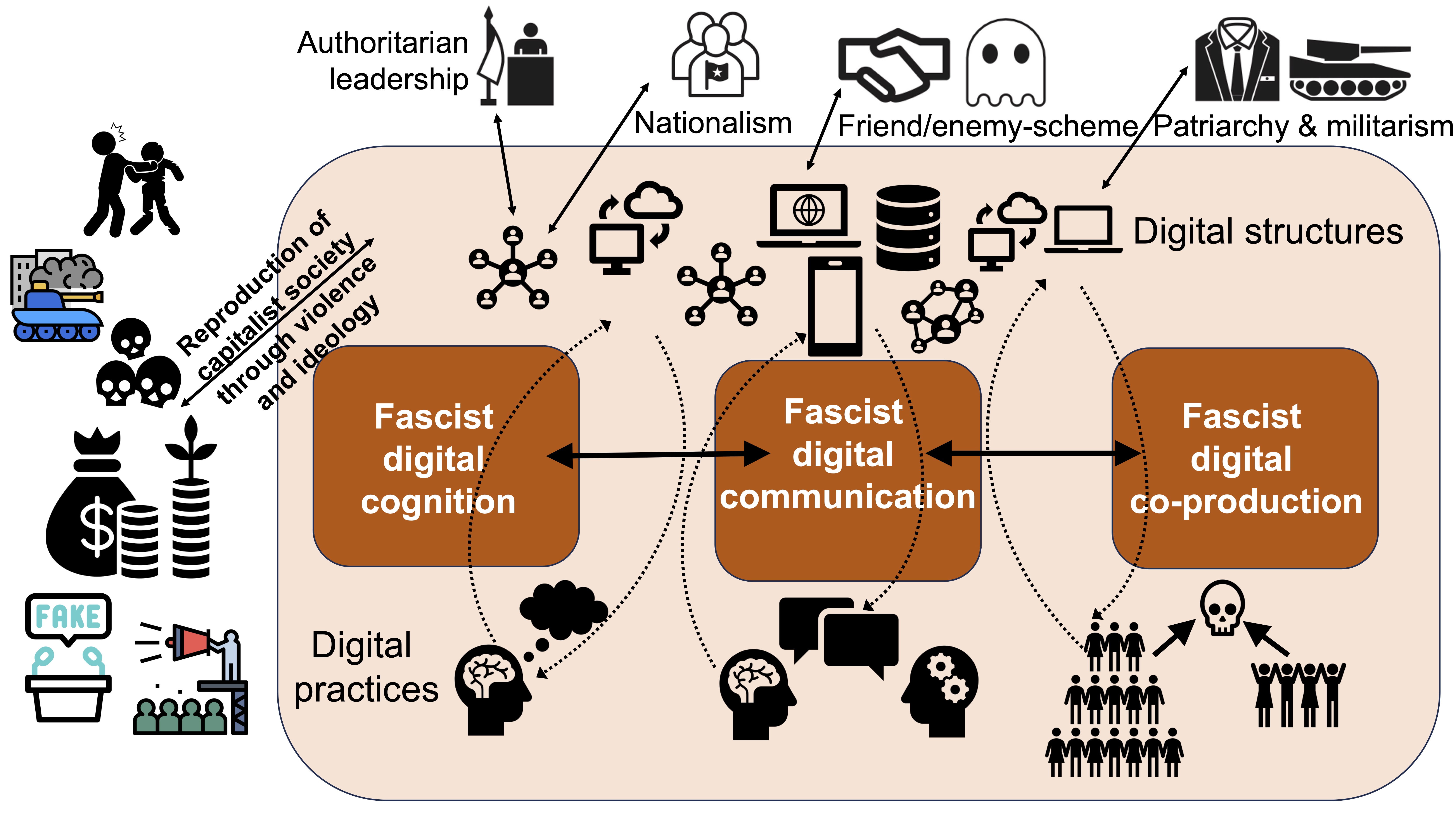
Figure 3: Digital fascism as a threefold semiotic process of fascist digital cognition, communication, and co-production
The figure visualises the duality of digital fascism. At the bottom of the figure, there are the digital practices of fascist digital cognition, communication, and co-production (the tripleC of digital fascism). On top, there are digital structures that mediate, that is, enable and constrain, digital practices by storing, distributing, and processing information[4]. These practices are interlinked. All digital communication presupposes and starts from digital cognition. All digital co-production presupposes and starts from digital communication. Fascist digital cognition means human beings’ individual production, organisation, and cognitive processing of fascist information supported by digital technologies. In fascist digital communication, humans communicate mediated by digital technologies in order to advance fascist goals. In fascist digital co-production, humans work together mediated by digital technologies with the goal of advancing fascism. Fascist digital practices (cognition, communication, co-production) have a common purpose, namely the advancement of fascism, which means that they aim at advancing authoritarian leadership, nationalism, the friend/enemy-scheme, patriarchy, and militarism as organising principles of society and are willing to do so by utilising ideology and violence as political means. Fascists are willing to use whatever means it takes to realise their fascist interests, including ideology, violence, and the combination of both. Propaganda and violence “have the identical purposes of making men amenable to control from above” (Neumann 1944/2009, 436). Given (digital) fascism’s massive use of both ideology and violence, it is profoundly anti-democratic. Fascist digital practices help reproduce capitalist society and interests by using digital means for dominating groups and individuals who are scapegoated for the ills of class society.
Table 4 gives an overview of some features of digital fascism. They all have the three dimensions of cognition, communication, and co-production. The tripleC model allows us to conceptualise the interconnected informational complexity of digital fascism. The dialectical duality of digital fascism operates based on the tripleC model. Users utilise digital technologies in order to cognitively construct, communicate, and co-produce fascism. All of these features interconnect digital practices and digital structures. They include fascist convergence, user-generated fascism/fascist digital prosumption, fascist digital ideology, algorithmic and AI-based digital politics, fascist cyber-attacks, fascist dataveillance, and fascist digital violence.
|
Feature |
Description |
Cognition |
Communication |
Co-production |
|
Fascist convergence |
the digital convergence of technologies, roles, and activities that supports fascism |
Digital technologies enable the convergence of different media (textual, audio, visual, audio-visual) in one digital multimedium, the convergence of different social roles, and the convergence of the semiotic processes of cognition, communication, and co-production, so that fascists can use one digital platform for multiple purposes in order to support achieving their goals. |
||
|
User-generated fascism, fascist digital prosumption |
users’ generation of fascist digital content. |
the individual production, publishing and consumption of fascist digital content. |
the digitally mediated communication of users about user-generated digital content and online content in general. |
users’ collaborative production and publishing of digital content. |
|
Fascist digital ideology |
users’ digital generation of fascist ideology that disinforms, lies, fabricates reality, and tries to deceive in order to support fascist interests. |
the individual production, publishing and consumption of fascist ideology, including, for example, by creating fake digital news; online hatred, tabloid online media (sensationalist, superficial, short, fast, scandalising, emotionalising; and polarising content), post-truth culture; deepfake videos, images and audio; ideological echo chambers and filter bubbles; spoof websites; online conspiracy theories; memes; fake social media profiles; orchestrated posts; etc. |
the digitally mediated communication of users about fascist ideology. |
users’ collaborative production of fascist online campaigns that aim at advancing fascist ideology, including the spread of fake content, tabloid media, online hate campaigns, astroturfing, echo chambers, etc. |
|
Algorithmic and AI-based fascist politics |
AI and algorithms are used to semi-automatically or fully automatically propagate fascism online |
the individual consumption of fascist digital content generated by AI or organised by algorithms; the individual production and design of AI or algorithms for fascist purposes |
the communication about AI-generated or algorithm-driven fascist
content; |
users’ collaborative production and design of AI or algorithms for
fascist purposes; |
|
Fascist cyber-attacks |
cyber-attacks for advancing fascist purposes, for example, including social engineering (phishing, etc), malware-based attacks, network and infrastructure attacks, exploitation of software vulnerabilities, co-ordinated digital attacks, online scams and frauds, etc. |
the individual orchestration of fascist cyber-attacks; a cyber-victim’s responses to a fascist cyber-attack |
communication about fascist cyber-attacks |
the collaborative orchestration of fascist cyber-attacks; collective responses to cyber-attacks |
|
Fascist dataveillance |
the digital surveillance of users and data collection practices, including big data collection and analytics, for fascist purposes |
the individual organisation of fascist dataveillance, a user’s responses to fascist dataveillance |
communication about fascist dataveillance |
the collaborative organisation of fascist dataveillance |
|
Fascist digital violence |
Digital violence for fascist purposes means the utilisation of digital technologies for killing or physically harming humans |
the individual organisation of fascist digital violence; a victim’s cognitive experience of digital violence |
communication about fascist digital violence |
the collaborative organisation of fascist digital violence |
Table 4: Features of digital fascism
Some media theorists and observers have claimed that the Internet and social media are forms of participatory digital culture that have made the digital world more democratic. For example, the media theorist Henry Jenkins argues that social media are spreadable media where consumers spread information so that culture becomes “far more participatory” (Jenkins et al. 2013, 1) and “the Web has become a site of consumer participation” (Jenkins 2008, 137). Many of such claims are based on over-enthusiasm for new technologies, entertainment, and popular culture (see Fuchs 2014, chapter 3). Those who make such claims often try to justify, rationalise, and idealise their status as fans.
Although already in the 1990s neo-Nazis used the Internet, in the early time of the WWW it was perhaps not foreseeable that digital fascism would become so powerful. Some of the 1990s tech-optimism, such as John Perry Barlow’s (1996) A Declaration of the Independence of Cyberspace, shared the hatred of democratic state regulation of the digital that is characteristic of digital neoliberalism and digital fascism, as well as their connection. Techno-optimism tends to overlook, ignore, or downplay the dark side of popular culture, entertainment, and digital technology, namely that they are also the playgrounds of fascist forces. In the 1990s, many observers laughed about the poor design of neo-Nazi websites and thought Internet culture was inherently progressive-minded. Today, digital tech moguls and far-right politicians are running their own alt-right platforms; and far-right parties, politicians and influencers achieve a huge number of followers on social media. Social media is also a realm of participatory fascism, where users make use of digital media’s affordances for spreading fascist propaganda.
Far-right parties and alt-right platforms utilise the discourse and categories of participatory and deliberative (digital) democracy. They talk about using digital media as anti-elitist tools, for direct citizen engagement, as a counter and alternative medium, and for enlightening users. As a consequence, arguing that user participation in politics and online debate advances democracy is not always and not necessarily true. Participatory digital democracy and deliberative digital democracy need to be combined with constitutional digital democracy that institutionalises “constitutional principles” (Habermas 1996, 298), such as civic and human rights as well as human dignity, in the context of digital practices.
Digital fascism has societal dimensions. There is an economy, a politics, and a culture of digital fascism. The economic dimension refers to the ownership of digital platforms that spread fascist content and to the funding and economic organisation of fascism online. The economic dimension is the base of digital fascism. You cannot produce, disseminate, and consume fascist ideas without means of communication that are produced and provided to users, which is an economic process. The political dimension of digital fascism refers to the way laws and policies enable and constrain digital fascism, digital fascism as a social movement, digital fascism’s colonisation of the public sphere, and the relationship of digital capital and the digital economy to politicians, political parties, and governments. The cultural dimension of digital fascism has to do with how users relate to digital fascism in their everyday practices in everyday life and with ideology of and on the Internet. Ideology of the Internet means that fascists make ideological claims about the Internet. Digital ideology takes two versions: techno-optimism and techno-pessimism. Digital media are either praised for making everything better or bedevilled as making everything worse. In any case, digital technology as such is said to do and result in this or that, which trivialises the dialectical relationship between technology and society.
Fascism has both temporal and spatial dimensions, as does the question of what new forms it may take. Spatially, the question is whether fascism is limited to certain parts of the world, such as the West, or whether it can emerge in all regions of the world. If one assumes that capitalism and imperialism are necessarily Western in character, then fascism, neo-fascism, and digital fascism must also be understood as necessarily Western phenomena. However, capitalism is global and constitutes a world-system, and there are different types of capitalism—not only neoliberal capitalism, but also state capitalism, oligarchic capitalism, and others. Therefore, capitalist systems such as Russia’s oligarchic fossil capitalism and China’s state capitalism also contain fascist potentials. Limiting fascism and authoritarianism geographically to the West results in a form of Occidentalism that can be misused for ideological purposes to whitewash actually existing fascist and authoritarian systems. Fascism, as a form of society, is a type of capitalism that can emerge wherever and whenever capitalism exists.
Critical theorists analysing the contemporary far-right have used concepts such as late fascism (Toscano 2023), neoliberal fascism (Giroux 2019), new fascism (Traverso 2019), and post-fascism (Tamás 2000). For such authors, fascism is not historically limited to Nazi fascism and Italian fascism, but a more general system that changes historically. Building on such dialectical historical approaches allows us to argue that there are continuities and discontinuities of fascism and to ask how digital media have transformed it.
There are ten faces of contemporary (digital) fascism that I have formulated in the form of working hypotheses:
Face 1 – societal context:
Classical fascism operated in the context of the crisis of financialised, industrial, state monopoly capitalism.
Contemporary fascism has operated in the context of the multiple crises of financialised, digital, neoliberal, flexible, global capitalism.
Face 2 – fascism and digital capitalism:
If fascism becomes powerful, it tends to be supported by dominant capital factions. Industrial capital supported classical fascism.
Some say that digital and communication capital, financial capital, and fossil/transport/energy capital support contemporary authoritarianism and fascism.
This development reflects the transition from industrial to global digital, financialised, fossil capitalism.
Face 3 – digital means of attack (digital violence and ideology
online):
Classical fascism predominantly used stormtroopers and human soldiers in armed conflict and monopolised, state-controlled broadcast media (such as the Volksempfänger) as a means of ideology.
Contemporary fascism, among other means, uses robotic, AI-based, and unmanned weapons systems that partly or fully automate warfare and reduce the role of humans on the battleground, as well as digital ideological means such as troll armies, online fake news, echo chambers, algorithmic politics, and social media, in order to attack defined enemies.
Fascism is anti-humanist; it has no respect for human life and human rights. The automation of warfare uses semi-autonomous or autonomous killing robots in order to increase damage and lethality. Such “posthuman” systems are particularly suited for fascist use because they allow to conduct mass killings at a distance without discerning between soldiers and civilians, merely motivated by the ideological programme of killing enemies that is a core feature of fascism that digital fascists, using AI and robotics, can programme into digital machines that kill at will.
Face 4 – user-generated fascism:
Classical fascism operated based on the central organisation of propaganda and lies, for which it utilised broadcasting and mass events.
Contemporary fascism also spreads propaganda and lies, but combines a centralised ideological apparatus with the organisation of user-generated post-truth, user-generated fake news and echo chambers/filter bubbles that spread fascist ideology. Digital media’s feature of prosumption enables user-generated fascism.
Face 5 – networked organisation and leadership:
Classical fascism was strictly organised top-down based on the leadership principle.
Contemporary fascism fetishises the leader, and more combines fascist leadership with networked, decentralised organisation, which has to do with digital media’s feature of convergence that breaks down barriers so that no central command of communication is needed.
Face 6 – creeping fascism:
Classical fascism openly opposed democracy. Contemporary fascism often disguises itself as and claims to be democratic. Contemporary fascism has a more imperceptible character. It tends to be a creeping fascism (Gross 1980) and democratic fascism (Amlinger and Nachtwey 2025) that stepwise undermines and negatively transforms democracy in order to abolish it.
Face 7 – the friend/enemy-scheme and nationalism:
Classical fascism defined the nation and the enemy primarily in terms of race and biology; contemporary fascism more defines the enemy and the nation based on culture and religion. Fascist biologism is not dead but has become subsumed under and incorporated into fascist culturalism.
Both classical and contemporary fascism construct conspiracy theories about a union of socialists, liberals, experts, and minorities (Jews, immigrants, refugees, people of colour, Muslims, etc.) that are said to rule the world. Classical fascism often racialised this proclaimed union, whereas contemporary fascism constructs such a union as one of “globalisers”, “metropolitan elites”, “political correctness”, “cultural Marxism”, etc.
Face 8 – emotional digital fascism:
Both contemporary and classical fascism appeal to human consciousness by combining emotions and ideology.
Contemporary fascism utilises AI, algorithms, big data, and computational social science for simulating, analysing, and manipulating emotions.
Face 9 – fascist popular digital culture:
While classical fascists resorted to entertainment by ridiculing enemies, contemporary fascists operate in the environment of digital popular culture. Therefore, some of them are themselves popular culture by operating as social media influencers, singers, musicians, reality TV stars, celebrities, etc. Contemporary fascists are often popular culture and produce popular culture. Although often wealthy and out of the ordinary, fascist leaders often present themselves as everyday common people/workers who have popular tastes, likes, and habits.
Face 10 – populist (social) media culture and fascism:
There is a structural parallel between tabloid media, the affordances of some social media platforms (such as the short video format on TikTok), and fascist movements’ logic of simplification, superficiality, and acceleration. This circumstance may explain why contemporary far-right actors tend to be quite active on social media.
These ten faces of digital fascism are novel features of fascism that distinguish the communication aspect of fascism from older forms of fascism. Based on the notion of digital fascism, I will next ask how digital capitalism and digital fascism are related.
The goal of this section is to outline how capital(ism) and fascism are related and what this means for digital capitalism and digital fascism. Building on Horkheimer’s 1939/1989, 78) dictum that there isSil an inherent connection between capitalism and fascism, the rise of new forms of fascism and authoritarianism, including digital fascism, does have an inherent connection to capital and capitalism. We are in this context especially interested in the connection of Silicon Valley digital capital to digital fascism.
In 2025, Donald Trump became the world’s most powerful politician. He was not just supported by the likes of Elon Musk and Peter Thiel, but his victory in the 2024 US presidential election was welcomed by the entire Silicon Valley tech elite.
On 4 September 2025, Donald Trump hosted a dinner with top Silicon Valley big tech CEOs at the White House. They included Sam Altman (OpenAI: ChatGPT), Tim Cook (Apple), Bill Gates (Microsoft), Safra Katz (Oracle), Sundar Pichai (Alphabet: Google, YouTube), and Mark Zuckerberg (Meta: Facebook, Instagram, WhatsApp). An iconic video (https://www.youtube.com/watch?v=dsl_sKYywEI, accessed on 16 March 2026) shows how the tech bosses celebrate and praise Trump. For example, they say to Trump:
Bill Gates:
Thank you for incredible leadership.
Sam Altman:
Thank you for being such a pro-business, pro-innovation president. It is a very refreshing change. We are very excited to see what you are doing to make all of our companies and our entire country so successful.
Tim Cook:
It is incredible to be among everyone here, particularly you and the First Lady. […] I want to thank you for setting the tone such that we can make a major investment in the United States.
Safra Katz:
You’ve unleashed American innovation and creativity.
Sundar Pichai:
Your administration is investing a lot. Already, the AI Action Plan under your leadership is a great start. And we look forward to working together. And thanks for your leadership.
The video not just shows the interconnection of big capital and big power, which exists in all forms and phases of capitalism, but it also shows that Silicon Valley’s digital capital elite favours Trump because they expect him to entirely deregulate the digital economy in and beyond the USA so that digital capital can globally do whatever it pleases in order to accumulate every more capital. That is why they celebrate Trump as an incredible pro-business and pro-innovation leader who unleashes digital innovation and creativity, etc. The unsettling reality is that the video shows that (digital) capital does not care about democracy and might support democracy today and authoritarianism tomorrow, depending on what system enables better and more capital accumulation. Digital capital organises vast shares of our online communication flows, taking place in the public sphere and the private sphere. When digital capital turns into fascist or authoritarian digital capital, democratic communication is at risk.
Classical fascism had industrial capital as its economic base, which was hegemonic. Contemporary fascism has the hegemonic factions of capital as its base, including digital capital, finance capital, and mobility capital (the oil and gas industry, the transport industry). Franz L. Neumann argues that the German industrialists “Thyssen, Kirdorf, and others paid the debts of the National Socialist party in 1932 […] The homes of the industrial leaders were open to Hitler and Ley, to Göring and Terboven. […] National Socialism and big business have identical interests. National Socialism pursues glory and the stabilization of its rule, and industry, the full utilization of its capacity and the conquest of foreign markets. German industry was willing to co-operate to the fullest. It had never liked democracy, civil rights, trade unions, and public discussion. National Socialism utilized the daring, the knowledge, the aggressiveness of the industrial leadership, while the industrial leadership utilized the anti-democracy, anti-liberalism and anti-unionism of the National Socialist party, which had fully developed the techniques by which masses can be controlled and dominated“ (Neumann 1944/2009, 360, 361).
Updating Neumann’s analysis, we can say that the homes of the Silicon Valley elite are open to contemporary authoritarians. The members of this elite see an identity of their interests and Trump’s interests. Trump’s programmatic mantra to “make America great again“includes making US capital and its hegemonic factions ever greater. That Trump is a capitalist himself makes it even easier for the tech elite to see him as one of their class and to praise him as their leader.
So, how exactly are capitalism and fascism related? Capitalism and fascism stand in a complex relationship in a number of ways:
· Fascism is a form of capitalism that is based on terror and violence as its main principles. Fascist society is necessarily a capitalist society where the accumulation of capital is realised with violent means, including warfare, forced labour, and terror.
· Crises of capitalist society can become fascism-producing crises (Eley 2015).
· Fascism as an ideology distracts from the complex causes of societal and social problems that are grounded in capitalist society, political economy, class relations, and domination. There are countless historical and contemporary examples that show how fascists construct scapegoats (such as Jews or migrants) for social ills (such as crime, as well as crises of housing, health care, education, employment, wages, pensions, the welfare state, etc.) in order to distract attention from the political-economic causes of such problems.
· In the friend/enemy-scheme as an ideological aspect of fascism, fascists appeal and try to mobilise human fears of alienation, that is, fears of the loss of wealth, money, status, power, identity, reputation, etc., that in capitalism have a property-like status through structures of accumulation that create social classes.
· Fascist movements require donors, among whom there have always been billionaires and the owners of large corporations.
· Capital is not inherently aligned with any political system but is politically flexible. It supports whatever political interest and system is most favourable for capital accumulation. As a consequence, when fascism is on the rise, certain capitalists or capital factions tend to switch over politically and ideologically towards fascism.
· Some say that digital capital is one of the capital factions that strongly support new fascist forces, as it hopes to thereby maintain and gain new accumulation opportunities.
· Neoliberal capitalism and fascism share the social Darwinian ideology of the survival of the fittest and cut-throat competition, disregard for the weak, the opposition to socialism and workers’ rights, the belief in the importance of strong leadership (CEO in the capitalist economy, dictator in authoritarian politics), anti-and post-humanism, and patriarchal structures.
Gebru and Torres (2024) characterise the ideology of Silicon Valley capital, especially AI capital, as “TESCREAL”: “transhumanism, Extropianism, singularitarianism, (modern) cosmism, Rationalism, Effective Altruism, and longtermism” (Gebru and Torres 2024, 2). Many digital capitalists think that digital and AI technologies can enable them to live forever. We can add to Gebru and Torres‘ analysis that there is a parallel between the TESCREAL ideology and capital accumulation, namely the expectation of temporal endlessness. TESCREAL wants to extend life ultimately into time. Capitalism wants to extend the accumulation of capital ever more by endlessly turning workers‘ labour-time into surplus-value and profit. Endless time is what connects capitalism and the TESCREAL ideology. Gebru and Torres point out one important aspect of digital capital’s ideology. Political economy aspects are, however, largely missing in their analysis. One unsettling aspect of digital capital is that it is at the same time post-ideological and hyper-ideological. Digital capital is so dominated by the interest of capital accumulation, which is not just the main economic feature of capitalism but also an ideology, that it no longer cares about what political worldview or ideology it supports and chooses the one that allows to maximise profit rates, which is why we today experience the convergence of digital capital(ism) and digital fascism.
According to Federal Election Commission filings compiled by OpenSecrets (2024), committees supporting Donald J. Trump in the 2024 cycle reported total receipts of approximately US$1.45 billion. OpenSecrets’ breakdown attributes roughly US$287.5 million to Elon Musk and US$150 million to Timothy Mellon across relevant committees and spending vehicles. These tallies reflect the site’s aggregation methodology and may change with amended filings. By that accounting, Musk represents ~19.8% and Mellon ~10.3% of donations for Trump (data source: OpenSecrets 2024). Mellon is an investor primarily active in the transport industry, especially railways and railroads. Elon Musk is the world’s richest person with an estimated wealth of around US$840 billion in March 2026 (data source: https://www.forbes.com/billionaires/, accessed on 13 March 2026). His main investments are in the transport industry (automotive industry: Tesla, space industry: SpaceX) and the digital industry (X, xAI). Other companies from the transport and transport-powering (oil, gas) sector that made major contributions to Trump’s 2024 campaign were Bigelow Aerospace and Energy Transfer LP. Andreessen Horowitz was another company from the digital industry that made a large contribution to Trump’s 2024 campaign. Important representatives of the transport/mobilities and digital industries publicly supported Trump or made significant contributions to committees backing him, which critics interpret as alignment with right-of-centre policy goals.
|
Industry |
Donation |
Share |
Number of Donors |
|
FIRE |
US$73,487,430 |
30.1% |
184 |
|
Energy and Transportation |
US$36,604,591 |
15.0% |
76 |
|
Communication and Digital |
US$28,796,605 |
11.8% |
64 |
|
Unknown |
US$23,477,892 |
9.6% |
120 |
|
Health |
US$18,746,000 |
7.7% |
57 |
|
Misc Business |
US$16,801,887 |
6.9% |
72 |
|
Other |
US$13,998,918 |
5.7% |
66 |
|
Agribusiness |
US$13,008,264 |
5.3% |
18 |
|
Construction |
US$5,294,576 |
2.2% |
30 |
|
Ideology/Single-Issue |
US$4,975,000 |
2.0% |
10 |
|
Defense |
US$4,650,000 |
1.9% |
6 |
|
Lawyers & Lobbyists |
US$4,345,186 |
1.8% |
26 |
|
Party/Non-contribs |
US$147 |
0.0% |
1 |
|
Total |
US$244.186.496 |
100.0% |
730 |
Table 5: Reported donors to Donald Trump’s 2025 presidential inauguration event, organised by industry, data source: OpenSecrets (2025), accessed on 7 October 2025
Trump raised almost US$250 million for his January 2025 presidential inauguration event. Table 5 gives an overview of the donors organised by industry. The main donor industries were FIRE (finance, insurance, real estate), energy and transportation, and the communication and digital industries. According to data from OpenSecrets (2025), the individuals and companies from the digital and communication industry making large contributions of US$ one million each to Trump’s 2025 inauguration were Adobe, Amazon, Applied Materials, AT&T, Charter Communications, Citrix Systems, Comcast, Coupang, Google, Gregory Brown (Motorola Solutions), Perplexity AI, C3 AI, Intuit, John Hering (Lookout), Broadcom Inc, Meta, Micron Technology, Nvidia, Qualcomm, Timothy Cook (Apple), Samuel Altman (OpenAI), Veeam Software, and Verizon Communications (data source: OpenSecrets 2025).
The data support my working hypothesis number 2 in the context of the Trump presidency, namely that financial capital, digital and communication capital, and fossil/transport/energy capital are particularly important supporters of right-wing authoritarianism. Digital capital is not the main and not the only supporter of Trump, but an important one. Big digital capital is among the types of capital that yield the highest rates of profit today (Fuchs 2024, 180: table 6.1). In 2022, the average profit rate of the world’s largest 18 media and digital corporations was 22.3 percent (Fuchs 2024, 180). Therefore, digital capitalists tend to embrace every system and ideology that supports endless capital accumulation. Not all, but only some of them, are ideologically convinced authoritarians. But by supporting authoritarians they become an active part of authoritarianism.
According to OpenSecrets (2024), Musk made
a huge contribution to Trump’s campaign. Analysts have described his
post-election role as unusually influential, though no official advisory
position has been confirmed. Some say that the world’s richest person fused his
economic power with the world’s politically most powerful person, which
resulted in an immense political-economic concentration of power. Musk not only
supported Trump but, for example, also publicly signalled support for Nigel
Farage’s Reform UK Party[5] and the
Alternative für Deutschland (Alternative for Germany)[6].
Some say Musk is a radical neoliberal who sees a very lean state as essential
for society: His ideal is “reducing government overreach, cutting taxes, and
deregulating the market“
Posthumanism decentres the human subject by focusing on the importance of machines in society and assuming that humans can turn into machines. Posthumanism’s and transhumanism’s omnipotence of the machine shows parallels to the fascist worship of speed, industry, mechanised violence, and the machinic ethos that was characteristic of Marinetti’s fascist futurism and the German Conservative Revolution that intellectually prepared the rise of Nazi-fascism.
Marinetti’s Futurist Manifesto illustrates techno-fetishism: “We declare that the splendor of the world has been enriched by a new beauty: the beauty of speed. A racing automobile with its bonnet adorned with great tubes like serpents with explosive breath ... a roaring motor car which seems to run on machine-gun fire, is more beautiful than the Victory of Samothrace. […] We want to glorify war – the only cure for the world – militarism, patriotism, the destructive gesture of the anarchists, the beautiful ideas which kill, and contempt for woman“ (Marinetti 1909). In a comparable manner, Ernst Jünger fetishised machines, both industrial machines and war machines, in books such as The Worker: “there are no machine-people; there are machines and people – but there exists a deep connection between the simultaneity of new means and a new humanity. To grasp this connection one must, however, make the effort to see through the steel and human masks of the times and infer the form, the metaphysics, that animates it. […] The clatter of looms in Manchester, the rattle of the machine guns at Langemarck – these are signs, words and phrases of a prose that is for us to decipher and master“ (Jünger 1932/2017, 80, 84).
The privileging of machines over humans is an ideology that can easily turn into the anti-humanism that fascism requires as one of its ideological bases. Historical fascism was ideologically based on the anti-humanist worship of machine power. Contemporary digital post- and transhumanism has a fascist ideological potential that, especially in situations of fascism-producing crises, can be politically activated. Neoliberal tech-optimism then turns into an ideological dimension of digital fascism. Silicon Valley’s TESCREAL ideology is characteristic of the post- and transhumanist ideology that can turn into fascist anti-humanism.
Musk characterises progressive thinking as
“woke mind virus“ (Musk 2024a). Musk has expressed nationalist concerns about
immigration, warning that it could cause a nation to “lose its identity in the
quest for globalism. A nation must maintain its core values and cultural
heritage to remain strong and united“
Musk opposes the existence of trade unions, saying “I disagree with the idea of unions […] I think the unions naturally try to create negativity in a company, and create a sort of lords and peasants situation“ (Musk 2023). He characterises himself as a “free speech absolutist”[7]. Many corporations’ commitment to tolerance, diversity, and freedom of expression often disappears the moment their financial interests are challenged. For example, according to Süddeutsche Zeitung, ZDF, which had previously published critical reports about Tesla, reported being denied accreditation for the inauguration of the Gigafactory Berlin-Brandenburg in March 2022 (Posselt 2022). In the worldview promoted by certain corporations, freedom of expression seems to apply only to those who refrain from questioning the unrestricted pursuit of profit.
Musk’s public statements reflect elements of neoliberal and techno-optimist ideology often associated with what scholars term authoritarian neoliberalism.
Meta/Facebook supported Trump’s inauguration event with one million dollars. Together with other tech moguls, Meta’s CEO and co-founder Mark Zuckerberg was present at the event. After the Cambridge Analytica scandal, public pressure resulted in Facebook’s adoption of a fact-checking programme. Shortly before Trump’s 2025 inauguration, Zuckerberg ended Meta’s fact-checking programme in the USA and claimed that the 2024 US presidential election that resulted in Trump’s win was a “cultural tipping point towards once again prioritising [free] speech“ and that Meta was therefore “restoring free expression on our platforms“ (Zuckerberg 2025). He also characterised fact-checkers as “too politically biased“ (Zuckerberg 2025). Fact-checkers are professional journalists who know how to check if certain claims are true or false. They are part of a news culture that works for free expression and against political bias. Critics argued that the decision effectively benefits far-right disinformation ecosystems by reducing moderation capacity.
Peter Thiel is one of the co-founders of PayPal and Palantir Technologies. The latter is a security and data analytics corporation. He created venture capital firms such as Founders Fund, Valar Ventures, and Mithril Capital and invested in companies such as Facebook, SpaceX, Airbnb, Spotify, etc. According to reports, Thiel donated US$1.25 million to Trump’s 2016 campaign and affiliated super PACs (Streitfeld 2016), spoke at the 2016 Republican National Convention, where he endorsed Trump publicly, was a member of Trump’s transition team after the first election victory, hosted Trump fundraisers, and encouraged Silicon Valley figures to engage with the Trump administration. Thiel has openly questioned democracy and favoured authoritarianism: “I no longer believe that freedom and democracy are compatible. […] Unlike the world of politics, in the world of technology the choices of individuals may still be paramount. The fate of our world may depend on the effort of a single person who builds or propagates the machinery of freedom that makes the world safe for capitalism“ (Thiel 2009). Such statements and Thiel’s actions are characteristic of the ideology of neoliberal authoritarianism.
Marc Andreessen co-founded Netscape Communications, which developed the popular WWW browser Netscape Navigator. In 2009, he, together with Ben Horowitz, founded the venture capital firm Andreessen Horowitz that invested in tech platforms such as Coinbase (cryptocurrency), Slack (collaboration and communication platform), Pinterest (image-sharing platform), DigitalOcean (cloud computing), Airbnb, Instagram, and Twitter. Andreessen supported Trump in the 2024 presidential campaign. According to data, Andreesen Horowitz donated around US$7 million to the 2024 Trump campaign (data source: OpenSecrets 2024). Andreessen announced his support of Trump publicly in 2024, saying that the Biden administration overtaxed and overregulated tech corporations (Temkin 2024).
In 2023, Andreessen (2023) published The Techno-Optimist Manifesto, which some see as a radical neoliberal and libertarian work that celebrates digital capitalism and fetishizes digital technologies. He wants to accelerate and radicalise digital capitalism and bases this demand on the techno-determinist assumption that digital tech is the solution to society’s problems and only has positive impacts: “Technology is the glory of human ambition and achievement, the spearhead of progress, and the realization of our potential. […] We believe in accelerationism – the conscious and deliberate propulsion of technological development – to ensure the fulfillment of the Law of Accelerating Returns. To ensure the techno-capital upward spiral continues forever. […] The techno-capital machine works for us. All the machines work for us“ (Andreessen 2023). In this manifesto, Andreesen portrays the state as a centralised planner, inefficient, knowledge-poor, and ultimately harmful to prosperity. The manifesto instead champions markets and technological entrepreneurship as the true engines of progress. “We believe markets are an inherently individualistic way to achieve superior collective outcomes”. Andreessen advances the friend/enemy-thinking typical of authoritarianism and identifies any idea and policy that wants to regulate corporate power as enemy: “We have enemies. … Our present society has been subjected to a mass demoralization campaign […] – against technology and against life – under varying names like ‘existential risk’, ‘sustainability’, ‘ESG’, ‘stakeholder capitalism’, ‘Precautionary Principle‘, ‘trust and safety‘, ‘tech ethics‘, ‘risk management‘, ‘de-growth‘, ‘the limits of growth’.”. Andreessen’s worldview is a radical capitalism that is unconstrained by the state, combined with elements of authoritarianism. As a consequence, it is no surprise that he has endorsed Donald Trump.
Curtis Yarvin is a blogger, writer, and software developer. Among others, Peter Thiel (Gellman 2023), Marc Andreessen[8], and J. D. Vance (Murphy and Vance 2021) have cited Yarvin as an influence or interesting thinker. Yarvin created the intellectual foundation of what the philosopher of the digital Nick Land (2023) terms the “Dark Enlightenment”, which is a philosophical base of the alt-right. Yarvin has significantly influenced the intellectual foundations of contemporary authoritarianism.
In writings under the pen name “Mencius Moldbug”, Yarvin has called for replacing democracy with the fusion of capitalism and dictatorship, a monarchy governed by a political CEO that turns the state into a giant corporation, a kind of CEO monarchy. He argues to “find the world’s best CEO, and give him undivided control over budget, policy and personnel“ (Moldbug 2008, 136) and “absolute sovereign authority“ (Moldbug 2009, 259). Moldbug propagates “the downfall of the Constitution and its replacement with an iron-hard corporate dictatorship“ (Moldbug 2009, 265). He claims that any problem can be “fixed by installing new management with plenary authority“ (Moldbug 2008, 321). Yarvin writes that “Hitler was a genius“ (Moldbug 2009, 184) and that “Mussolini did a fine job with the Mafia“ (Moldbug 2009, 184). Moldbug propagates turning the state into a company. He writes about hypothetical thought experiment where a movement introduces a system characterised as “racist corporate fascism“ (Moldbug 2008, 291).
The discussion of how digital tech moguls support authoritarianism could be continued, but we have to stop here. Public statements and political donations by figures such as Elon Musk, Mark Zuckerberg, Peter Thiel, Marc Andreessen, and Curtis Yarvin have been interpreted in scholarly and journalistic commentary as indicative of a broader trend in which segments of digital capital align with authoritarian or nationalist politics.
Digital capital is one of the capital fractions that, in the current global context marked by the rise of new right-wing movements, tends to intersect with or enable authoritarian governance, contributing to what may be described as authoritarian digital capitalism. The boundary between authoritarian digital capitalism and digital fascism is often fluid.
Many of the analysed worldviews have in common the strong opposition to state regulation of corporations, technological determinism, the fetishism of strongman leadership, and the belief in some aspects of the social Darwinian ideology of the survival of the fittest in the economy and society.
In their essay “The Californian Ideology”, the media and political theorists Richard Barbrook and Andy Cameron argue that Silicon Valley digital culture shares the ideology of neoliberalism with right-wing ideology : “West Coast ideologues have embraced the laissez-faire ideology“ (Barbrook and Cameron 1996/2015, 17) and favour the creation of an “electronic marketplace“ (17). The two thinkers say that Silicon Valley ideology is blind towards the “racism, poverty and environmental degradation“ (13) the neoliberal digital tech model is based on, as is, for example, evidenced by poor working conditions that many immigrant workers have faced in Silicon Valley chip manufacturing (22). In the age of new fascism, some say that the Californian ideology has been sublated so that it enters a new stage and becomes the Californian ideology 2.0, an ideology that actively funds and supports authoritarian and fascist politics that are xenophobic, racist, nationalist, anti-democratic, and dictatorial.
Little and Witch (2021) stress that Silicon Valley tech gurus such as Elon Musk, Jeff Bezos, Mark Zuckerberg, Peter Thiel, Larry Page, and Sergey Brin are predominantly men who constitute a “patriarchal digital capitalism“ (Little and Witch 2021, 184). Fascism has traditionally been based on patriarchal values and practices such as the idealisation of the male soldier and the confinement of women to the household, which is why patriarchal digital capitalism matters when we analyse digital fascism. There are female digital tech founders and top managers such as Donna Dubinsky (Palm), Adriana Gascoigne (Girls in Tech), Diane Greene (VMware), Julia Hu (Lark Health), Sandy Lerner (Cisco), Marissa Mayer (Dazzle, Sunshine, Yahoo!, Google), Kim Polese (Marimba, SpikeSource), and Sheryl Sandberg (Meta/Facebook, Google). Just like there are women leaders in far-right politics, including Marine Le Pen and Alice Weidel, there are women CEOs and managers in the digital capitalist economy. Parts of contemporary patriarchy have turned from conservative family values into a neoliberal and corporate feminism that is based on what Arruzza, Bhattacharya, and Fraser (2019) term “equal opportunity domination“, the management of “exploitation in the workplace and oppression in the social whole shared equally by ruling-class men and women“ (2). The three authors argue that “Sandberg and her ilk see feminism as a handmaiden of capitalism“ (2). Neoliberalism, new fascism, and neoliberal authoritarianism and fascism do not simply or not only reproduce classical patriarchy but advance a transformed patriarchy where women join men as authoritarian business and political leaders who dominate the working class and other groups. The patriarchs of digital capitalism try to “[s]uppress any sort of challenge to authority from trade unions, shareholders, or state oversight” (Little and Witch 2021, 217). They include women who reproduce and share the values of capitalism and authoritarianism.
Rainer Mühlhoff (2025, 14-16, 118-119) argues that anti-democracy, violence, and technology as an instrument of power are fascism’s three key features. In what he terms the new fascism, the AI industry has become closely aligned with fascist politics. In the new fascism, according to Mühlhoff, AI is used as an instrument of fascist power. Mühlhoff argues that the new fascism uses AI as a key technology for creating mass surveillance systems and algorithmic predictions for classifying, discriminating, repressing, and potentially eliminating individuals and certain groups. His approach seems to be based on the assumption that AI is inherently fascist. This is quite a wide-ranging and fundamental claim. It implies that AI can never be used for advancing the common good and a democratic society. Not everyone will share such assumptions.
The work of the philosopher John R. Searle on AI allows a different interpretation of AI. Searle (1980) distinguishes between strong and cautious/weak AI:
“According to weak AI, the principal value of the computer in the study of the mind is that it gives us a very powerful tool. For example, it enables us to formulate and test hypotheses in a more rigorous and precise fashion. But according to strong AI, the computer is not merely a tool in the study of the mind; rather, the appropriately programmed computer really is a mind, in the sense that computers given the right programs can be literally said to understand and have other cognitive states. In strong AI, because the programmed computer has cognitive states, the programs are not mere tools that enable us to test psychological explanations; rather, the programs are themselves the explanations“ (Searle 1980, 417).
Strong AI is a form of technological fetishism. It assumes that the computer is more powerful than the human brain and can, therefore, imitate, simulate, automate, and surpass human activity. It is based on the moral assumption that digital machines are more important and superior to human beings. It is precisely such anti-humanism that unites contemporary fascists and certain representatives of the AI and digital industries. In contrast, cautious AI does not believe in the feasibility and desirability of replacing human brain work by AI but sees it as a technology that should be designed and used for augmenting and not replacing human beings‘ central activities. Against the assumption that all AI is fascist, we can put forward the hypothesis that there are fascist and democratic, humane ways of designing and using AI and digital technologies, which means that certain forms of AI may show features that can easily be put to fascist use, and other forms of AI may show features that can more easily be put to democratic use. There are always potential, unpredictable and unforeseeable consequences and uses, so the exact impacts of AI on society can never be predicted.
In the 1970s, the cultural theorist Raymond Williams (1974/2004) wrote on television and society, arguing against technological determinism that societal and technological development interact dialectically. Based on Williams, we can say that in the case of AI, as in the case of other technologies, human “intention“ shapes “the process of research and development“; AI is “being looked for and developed with certain purposes and practices already in mind“ (Williams 1974/2004, 7).
Digital capitalism and digital fascism have been intersecting and interacting in multiple ways. Representatives of digital capital have financially, politically, and ideologically supported far-right parties and politicians. There are parallels between Silicon Valley’s Californian ideology, neoliberal ideology, and fascist ideology that have resulted in a new fusion, digital capitalist authoritarianism and fascism.
Classical neoliberal theorists, such as Hayek and Friedman, argue that capitalism is a necessary foundation of democracy: “If ‘capitalism‘ means here a competitive system based on free disposal over private property, it is far more important to realize that only within this system is democracy possible. When it becomes dominated by a collectivist creed, democracy will inevitably destroy itself“ (Hayek 1944/2001, 73). “History suggests only that capitalism is a necessary condition for political freedom“ (Friedman 1962/1982, 17). Contemporary developments show the falseness of these claims. Capital tends to support whatever political system best helps advance its interests, which is why today we see the tendency of the fusion of digital capitalism and digital fascism. Slobodian (2025, 29) argues that “Hayek’s theory resemble[s] social Darwinism“, which is a door that connects neoliberalism to digital ideology and fascism.
This essay has argued that the spectacle of Trump’s 2025 inauguration – studded with the world’s most powerful tech magnates – signals a tightening fusion of digital capital and authoritarian politics. To make sense of this conjuncture, it reframes fascism through the Frankfurt School’s lens of authoritarianism, centring capitalism rather than bracketing it out. Fascism is defined as a terroristic, anti-democratic form of right-wing authoritarianism organised around leadership cults, nationalism, friend/enemy polarisation, and militant patriarchy – above all, the legitimation and institutionalisation of violence. This perspective explains why fascism tends to intensify in capitalist crises and why it so often collaborates with conservative economic elites, translating objective insecurities into authoritarian consciousness and mobilisation.
The “digital” matters here not as a neutral toolkit but as a socio-technical terrain shaped by convergence and prosumption, which dissolve boundaries between production/consumption and online/offline life. The essay conceptualises digital fascism as a duality: fascist practices (cognition, communication, co-production) and digital structures recursively produce one another – the tripleC dynamic. This dialectic underwrites concrete features such as user-generated hate and disinformation, algorithmic targeting and bot armies, cyber-attacks, dataveillance, and digitally mediated threats and violence. In ten working hypotheses, the essay maps historical continuities and shifts: from centrally orchestrated broadcast propaganda to hybrid influencer networks; from racially codified enemies to culture-war fronts; from street militias to partially automated conflict; and from open anti-democracy to “creeping” claims of being the true democracy while hollowing it out.
Finally, the essay connects these dynamics to digital capitalism’s political economy. Capital is politically flexible, and in the present development phase of capitalism, key capital fractions – finance, fossil/transport, and especially digital/communications – supply funds, platforms, and ideology to emergent authoritarian projects. Some will say that figures such as Musk, Zuckerberg, Thiel, Andreessen, and Yarvin illustrate what might be called a Californian ideology 2.0 – a techno-determinist and neoliberal worldview that valorises markets, innovation, and leadership while showing scepticism toward regulation, labour organisations, and egalitarian redistribution. More broadly, the danger today lies in the rise of an authoritarian digital capitalism whose boundary with digital fascism appears increasingly porous.
Franz L. Neumann argued about the relationship between Nazi-Germany and capitalism:
“[The German industrialists] Thyssen, Kirdorf, and others paid the debts of the National Socialist party in 1932, and today it is no secret that industry financed the party in the past; this is openly admitted by Deutsche Volkswirt. The homes of the industrial leaders were open to Hitler and Ley, to Göring and Terboven. […] National Socialism and big business have identical interests. National Socialism pursues glory and the stabilization of its rule, and industry, the full utilization of its capacity and the conquest of foreign markets. German industry was willing to co-operate to the fullest. It had never liked democracy, civil rights, trade unions, and public discussion. National Socialism utilized the daring, the knowledge, the aggressiveness of the industrial leadership, while the industrial leadership utilized the anti-democracy, anti-liberalism and anti-unionism of the National Socialist party, which had fully developed the techniques by which masses can be controlled and dominated“ (Neumann 1944/2009, 360, 361).
Today, fascism’s power is constituted not against but through digital capitalism. Digital capital and other class factions support authoritarianism and/or fascism to destroy working-class interests, suppress human rights, repress minorities, and accumulate capital in unconstrained manners.
Countering digital fascism requires not techno-optimism or techno-pessimism but constitutional digital democracy: enforceable rights, robust regulation of platform power and data exploitation, protections for workers and unions, and a public sphere fortified against post-truth. In addition, we need a resilient digital democracy – a new form of participatory digital democracy in which public service Internet projects and platform cooperatives establish autonomy from the power of digital capital (Fuchs 2026). Echoing the critical theorist Franz L. Neumann (see also Fuchs 2017), we want to close this essay by stressing that education and political action are twin duties if liberty is to survive the digital age:
“Politics, again, should be a dual thing
for us: the penetration of the subject matter of our academic discipline with
the problems of politics – naturally, not day-to-day politics – and the taking
of positions on political questions. If we are serious about the humanization
of politics; if we wish to prevent a demagogue from using anxiety and apathy,
then we – as teachers and students – must not be silent. We must suppress our
arrogance, inertia, and our revulsion from the alleged dirt of day-to-day politics.
We must speak and write. […] Only through our own responsible educational and
political activity can the words of idealism become history” (Neumann
1954/2017, 629).
Adorno, Theodor W., Else Frenkel-Brunswik, Daniel J. Levinson and R. Nevitt Sanford. 1950. The Authoritarian Personality. New York: Harper & Brothers.
Amlinger, Carolin & Oliver Nachtwey. 2025. Zerstörungslust. Elemente des demokratischen Faschismus. Berlin: Suhrkamp.
Andersen, Ross, and Brigid Hains. 2014. Exodus Elon Musk Argues That We Must Put a Million People on Mars If We Are to Ensure That Humanity Has a Future. Aeon, 30 September 2014. https://aeon.co/essays/elon-musk-puts-his-case-for-a-multi-planet-civilisation
Andreessen, Marc. 2023. The Techno-Optimist Manifesto. https://a16z.com/the-techno-optimist-manifesto/ (accessed on 7 October 2025).
Arendt, Hannah. 1970. On Violence. Boston: Houghton Mifflin Harcourt.
Arruzza, Cinzia, Tithi Bhattacharya, and Nancy Fraser. 2019. Feminism for the 99 Percent. A Manifesto. London: Verso.
Barbrook, Richard and Andy Cameron. 1996/2015. The Californian Ideology. In Richard Barbrook with Andy Cameron. 2015. The Internet Revolution, 12-27. Amsterdam: Institute of Network Cultures.
Barlow, John Perry. 1991. Private Life in Cyberspace. Communications of the ACM 34 (8): 23-25.
Barlow, John Perry. 1996. A Declaration of the Independence of Cyberspace. https://www.eff.org/cyberspace-independence
Bartlett, Jamie, Jonathan Birdwell, and Mark Littler. 2011. The New Face of Digital Populism. London: Demos.
Benkler, Yochai, Robert Faris & Hal Roberts. 2018. Network Propaganda. Manipulation, Disinformation, and Radicalization in American Politics. Oxford: Oxford University Press.
Bobba, Giuliano. 2021. Digital Populism. How the Web and Social Media are Shaping Populism in Western Democracies. In Political Populism. Handbook of Concepts, Questions and Strategies of Research, edited by Reinhard Heinisch, Christina Holtz-Bacha and Oscar Mazzoleni, 457-468. Baden-Baden: Nomos-Verlag, 2021.
Bobbio, Norberto. 1996. Left and Right. The Significance of a Political Distinction. Chicago, IL: The University of Chicago Press.
Bratich, Jack Z. 2022. On Microfascism. Brooklyn, NY: Common Notions.
Brecht, Bertolt. 1932/2000. The Radio as an Apparatus of Communications. In Brecht on Film & Radio, edited by Marc Silberman, 41–46. London: Methuen.
Cadwalladr, Carole. 2025. It’s not too Late to Stop Trump and the Tech Broligarchy from Controlling our Lives, but we Must Act Now. The Guardian, 20 April 2025, https://www.theguardian.com/global/2025/apr/20/carole-cadwalladr-ted-talk-this-is-what-a-digital-coup-looks-like-its-not-too-late-to-stop-trump-and-the-silicon-valley-broligarchy-from-controlling-our-lives-but-we-must-act-now
Caporaso, James A. and David P. Levine. 1992. Theories of Political Economy. Cambridge: Cambridge University Press.
Carter, Paul. 2014. Material Thinking. New York: Simon and Schuster.
Cassani, Andrea and Luca Tomini. 2019. Autocratization in Post-Cold War Political Regimes. Cham: Palgrave Macmillan.
Coeckelbergh, Mark. 2026. Technofascism:
AI, Big Tech, and the New Authoritarianism. AI & Society, https://doi.org/10.1007/s00146-026-02862-9
Croissant, Aurel and Luca Tomini, eds. 2024. The Routledge Handbook of Autocratization. Abingdon: Routledge.
Degeling, Jasmin. 2024. Differential Distributions of the Digital: A Gender Media Studies Perspective on the Theory of Fascism and Current Digital Media Cultures. Digital Culture & Education 15 (2): 9-21.
Demír, Mustafa. 2025. From Ideology to Algorithms, The New Face of Fascism: Digital Fascism. Anemon 13 (1): 232-272.
Eatwell, Roger. 1996. On Defining the “Fascist Minimum”: The Centrality of Ideology. Journal of Political Ideologies 1 (3): 303-319.
Eley, Geoff. 2015. Fascism Then and Now. Socialist Register 52: 91-117.
Enzensberger, Hans
Magnus. 1970. Constituents of a Theory of the Media. New Left Review I (64): 13–36.
Fielitz, Maick and Holger Marcks. 2022. Digitaler Faschismus: Die sozialen Medien als Motor des Rechtsextremismus. Berlin: Duden.
Fielitz, Maick and Holger Marcks. 2019. Digital Fascism: Challenges for the Open Society in Times of Social Media. https://escholarship.org/content/qt87w5c5gp/qt87w5c5gp_noSplash_cfd533213b94bd55da882f6f1940753e.pdf
Frantz, Erica, Andrea Kendall-Taylor, and Joseph Wright. 2020. Digital Repression in Autocracies. Users Working Paper Series 2020: 27. Gothenburg: University of Gothenburg.
Friedman, Milton. 1962/1982. Capitalism and Freedom. Chicago, IL: The University of Chicago Press.
Fromm, Erich. 1984. The Working Class in Weimar Germany. Leamington Spa: Berg.
Fromm, Erich. 1941/1969. Escape From Freedom. New York: Avon Books.
Fromm, Erich. 1936/2020. Studies on Authority and Family. Sociopsychological Dimensions. Fromm Forum 24: 8-58.
Fuchs, Christian. 2026. What is and How Do We Achieve a Resilient Digital Democracy? Open Research Europe 5 (387), https://doi.org/10.12688/openreseurope.21988.2
Fuchs, Christian. 2025. World War and World Peace in the Age of Digital Capitalism. London: University of Westminster Press. DOI: https://doi.org/10.16997/mpub.13082283
Fuchs, Christian. 2024. Social Media: A Critical Introduction. London: Sage. Fourth edition.
Fuchs, Christian. 2022. Digital Fascism. Abingdon: Routledge.
Fuchs, Christian. 2020. Communication and Capitalism: A Critical Theory. London: University of Westminster Press. DOI: https://doi.org/10.16997/book45
Fuchs, Christian. 2018a. Authoritarian Capitalism, Authoritarian Movements and Authoritarian Communication. Media, Culture & Society 40 (5): 745-753.
Fuchs, Christian. 2018b. Digital Demagogue. Authoritarian Capitalism in the Age of Trump and Twitter. London: Pluto.
Fuchs, Christian. 2017. The Relevance of Franz L. Neumann’s Critical Theory in 2017: “Anxiety and Politics” in the New Age of Authoritarian Capitalism. tripleC: Communication, Capitalism & Critique 15 (2): 637-650. DOI: https://doi.org/10.31269/triplec.v15i2.903
Fuchs, Christian. 2014. Social Media: A Critical Introduction. London: Sage. First edition.
Gebru, Timnit and Émile P. Torres. 2024. The TESCREAL Bundle: Eugenics and the Promise of Utopia through Artificial General Intelligence. First Monday 29 (4), https://doi.org/10.5210/fm.v29i4.13636
Gellman, Barton. 2023. Peter Thiel is Taking a Break from Democracy. The Atlantic, 9 November 2023. https://www.theatlantic.com/politics/archive/2023/11/peter-thiel-2024-election-politics-investing-life-views/675946/
Gerbaudo, Paolo. 2024. Digital Populism. In Research Handbook on Populism, edited by Yannis Stavrakakis and Giorgos Katsambekis, 506-515. Cheltenham: Edward Elgar.
Gerbaudo, Paolo. 2018. Social Media and Populism: An Elective Affinity? Media, Culture & Society 40 (5): 745-753.
Giddens, Anthony. 1994. Beyond Left and Right. The Future of Radical Politics. Cambridge: Polity.
Giddens, Anthony. 1984. The Constitution of Society. Outline of a Theory of Structuration. Cambridge: Polity.
Giroux, Henry. 2019. The Terror of the Unforeseen. Los Angeles, CA: LA Review of Books.
Gosztonyi, Gergely. 2023. Censorship from Plato to Social Media. Cham: Springer.
Griffin, Roger. 2003. Fascism. In The Blackwell Dictionary of Modern Social Thought, ed. William Outhwaite, 231-234. Malden, MA: Blackwell. Second edition.
Griffin, Roger. 1993. The Nature of Fascism. Abingdon: Routledge.
Gross, Bertram. 1980. Friendly Fascism. Boston, MA: South End Press.
Habermas, Jürgen. 1996. Between Facts and Norms. Contributions to a Discourse Theory of Law and Democracy. Cambridge, MA: The MIT Press.
Harvey, David. 2018. Universal Alienation. tripleC: Communication, Capitalism & Critique 16 (2): 424-439. https://doi.org/10.31269/triplec.v16i2.1026
Hayek, Friedrich. 1944/2001. The Road to Serfdom. Abingdon: Routledge.
Hofkirchner, Wolfgang. 2023. The Logic
of the Third. A Paradigm Shift to a Shared Future for Humanity. Singapore: World Scientific
Horkheimer, Max, ed. 1936/1987. Studien über Autorität und Familie. Lüneburg: zu Klampen.
Horkheimer, Max. 1936/1972. Authority and the Family. In Critical Theory: Selected Essays, 47-128. New York: Continuum.
Horkheimer, Max. 1939/1989. The Jews and Europe. In Critical Theory and Society: A Reader, edited by Stephen E. Bronner and Douglas Kellner, 77-94. New York: Routledge.
Illouz, Eva. 2023. The Emotional Life of Populism. How Fear, Disgust, Resentment, and Love Undermine Democracy. Cambridge: Polity.
Jenkins, Henry. 2008. Convergence Culture. New York: New York University Press.
Jenkins, Henry, Sam Ford, and Joshua Benjamin Green. 2013. Spreadable Media: Creating Value and Meaning in a Networked Culture. New York: New York University Press.
Jünger, Ernst. 1932/2017. The Worker: Dominion and Form. Evanston, IL: Northwestern University Press.
Kittler, Friedrich. 1993. Draculas Vermächtnis. Technische Schriften. Leipzig: Reclam.
Klikauer, Thomas and Norman Simms. 2021. How Digital Fascism Works. Counter Currents, 13 February 2021, https://countercurrents.org/2021/02/how-digital-fascism-works/
Kingsmith, A. T. and Brett Zehner. 2025. Ghosts in the Machine: Algorithmic Fascism and the Psychopolitics of Crisis. Journal of Psychosocial Studies 18 (1): 110-114. DOI: https://doi.org/10.1332/14786737Y2025D000000042
Laclau, Ernesto. 2005. On Populist Reason. London: Verso
Langlois, Ganaele. 2021. Faking it Until it is Real. In Really Fake, edited by Alexandra Juhasz, Gabaele Langlois, and Nishant Shah, 1-9. Minneapolis, MN: University of Minnesota Press.
Little, Ben and Alison Witch. 2021. The New Patriarchs of Digital Capitalism. Celebrity Tech Founders and Networks of Power. Abingdon: Routledge.
Lukács, Georg. 1971. History and Class Consciousness. Studies in Marxist Dialectics. Cambridge, MA: The MIT Press.
MacKinnon, Rebecca. 2012. Consent of the Networked. The Worldwide Struggle for Internet Freedom. New York: Basic Books.
MacKinnon, Rebecca. 2011. China’s ”Networked Authoritarianism”. Journal of Democracy 22 (2): 32-46.
Maerz, Seraphine F. 2024. The Internet and Autocratization. In The Routledge Handbook of Autocratization, edited by Aurel Croissant and Luca Tomini, 209-221. Abingdon: Routledge.
Manovich, Lev. 2002. The Language of New Media. Cambridge, MA: The MIT Press.
Marinetti, Filippo Tomasso. 1909. The Futurist Manifesto. http://bactra.org/T4PM/futurist-manifesto.html (accessed on 16 January 2025).
Marx, Karl. 1867/2024. Capital Volume 1. Princeton, NJ: Princeton University Press.
Marx, Karl. 1857/1858. Grundrisse. London: Penguin.
Marx, Karl. 1844. Economic and Philosophic Manuscripts of 1844. In Marx & Engels Collected Works (MECW) Volume 3, 229-346. London: Lawrence & Wishart.
Mirrlees, Tanner. 2019. The Alt-Right’s Platformization of Fascism and a New Left’s Digital United Front. Democratic Communiqué 28 (2): 28-46. DOI: https://doi.org/10.7275/democratic-communique.1693
Moldbug, Mencius. 2009. A Gentle Introduction to Unqualified Reservations. https://www.unqualified-reservations.org/pdfs/gentle_introduction_to_ur.pdf (accessed on 7 October 2025)
Moldbug, Mencius. 2008. An Open Letter to Open-Minded Progressives. https://www.unqualified-reservations.org/pdfs/open_letter.pdf (accessed on 7 October 2025)
Möllers, Norma. 2025. We Have Never Not Been Fascist: Infrastructures of State Violence as Technofascist Laboratories. Dialogues on Digital Society, DOI: https://doi.org/10.1177/29768640251377169
Mühlhoff, Rainer. 2025. Künstliche Intelligenz und der neue Faschismus. Ditzingen: Reclam.
Murphy, Jack and J. D. Vance. 2021. Jack Murphy Interview J. D. Vance. Jack Murphy Live, 17 September 2021. https://www.youtube.com/watch?v=PMq1ZEcyztY (accessed on 7 October 2025).
Musk, Elon. 2024a. Interview with Don Lemon. 18 March 2024. https://www.rev.com/transcripts/elon-musk-interview-with-don-lemon (accessed on 7 October 2025)
Musk, Elon. 2024b. “Warum Elon Musk Auf Die AfD Setzt.” Die Welt Am Sonntag, December 29, 2024. English version: https://x.com/martinvars/status/1874595053450002617
Musk, Elon. 2023. Interview with Elon Musk at the New York Times DealBook/Summit 2023. 23 November 2023, https://www.rev.com/transcripts/dealbook-summit-2023-elon-musk-interview-transcript (accessed on 7 October 2025)
Musk, Elon, and Alice Weidel. 2025. Conversation: Alice Weidel & Elon Musk. 9 January 2025. https://www.youtube.com/watch?v=UlFyJmQQNtQ (accessed on 7 October 2025).
Neumann, Franz L. 1957/2017. Anxiety and Politics. tripleC: Communication, Capitalism & Critique 15 (2): 612-636. DOI: https://doi.org/10.31269/triplec.v15i2.901
Neumann, Franz. 1944/2009. Behemoth: The Structure and Practice of National Socialism, 1933-1944. Chicago, IL: Ivan R. Dee.
OpenSecrets. 2025. Trump Administration: 2025 Inauguration Donors, https://www.opensecrets.org/trump/2025-inauguration-donors (accessed on 7 October 2025).
OpenSecrets. 2024. Presidential Elections: 2024: Donald Trump (R). https://www.opensecrets.org/2024-presidential-race/donald-trump/candidate?id=N00023864 (accessed on 6 October 2025).
Orlikowski, Wanda J. 1992. The Duality of Technology: Rethinking the Concept of Technology in Organizations. Organization Science 3 (3): 398-427.
Paxton, Robert O. 2004. The Anatomy of Fascism. New York: Knopf.
Payne, Stanley G. 1995. A History of Fascism, 1914-45. London: Routledge.
Pearson, James S. 2024. Defining Digital Authoritarianism. Philosophy & Technology 37, https://doi.org/10.1007/s13347-024-00754-8
Pool, Ithiel de Sola. 1983. Technologies of Freedom. Cambridge, MA: The Belknap Press.
Posselt, Timo. 2022.
Kein Zutritt. Süddeutsche Zeitung, 25 March 25 2022. https://www.sueddeutsche.de/medien/tesla-zdf-akkreditierung-1.5554484
Rasmussen, Mikkel Bolt. 2022. Late Capitalist Fascism. Cambridge: Polity.
Redecker, Eva von. 2026.
Dieser Drang nach Härte. Über den neuen Faschismus. Frankfurt am Main:
S. Fischer.
Redecker, Eva von. 2020. Ownership’s Shadow: Neoauthoritarianism as Defense of Phantom Possession. Critical Times 3 (1): 33-67. https://doi.org/10.1215/26410478-8189849
Reich, Wilhelm. 1933/1972. The Mass Psychology of Fascism. London: Souvenir Press.
Ritzer, George. 2015. Prosumer Capitalism. The Sociological Quarterly 56 (3): 413-445. https://doi.org/10.1111/tsq.12105
Roberts, Tony and Marjoke Oosterom. 2024. Digital Authoritarianism: A Systematic Literature Review. Information Technology for Development, https://doi.org/10.1080/02681102.2024.2425352
Searle, John R. 1980. Minds, Brains and Programs. Behavioral and Brain Sciences, 3: 417-424.
Sinpeng, Aim and Youngjoon Koh. 2022. Journalism in the Age of Digital Autocracy: A Comparative ASEAN Perspective. Journal of ASEAN Studies 10 (2): 247−262.
Slobodian, Quinn. 2025. Hayek’s Bastards. New York: Zone Books.
Stanley, Jason. 2018. How Fascism Works. The Politics of Us and Them. New York: Random House.
Streitfeld, David. 2016. Peter Thiel to Donate $1.25 Million in Support of Donald Trump. The New York Times, 16 October 2016, https://www.nytimes.com/2016/10/16/technology/peter-thiel-donald-j-trump.html
Strick, Simon. 2023. Reflexive Fascism in the Age of History Memes. Journal of Modern European History 20 (3): 335-351. DOI: https://10.1177/16118944x51
Strick, Simon. 2021. Rechte Gefühle: Affekte und Strategien des digitalen Faschismus. Bielefeld: transcript.
Tamás, Gáspár Miklós. 2000. On Post-Fascism. East European Constitutional Review 9: 48-56.
Temkin, Marina. 2024. Andreesen Horowitz co-Founders Explain Why They’re Supporting Trump. TechCrunch, 16 July 2024. https://techcrunch.com/2024/07/16/andreessen-horowitz-co-founders-explain-why-theyre-supporting-trump
Thiel, Peter. 2009. The Education of a Libertarian. https://www.cato-unbound.org/2009/04/13/peter-thiel/education-libertarian/ (accessed on 7 October 2025)
Thompson, Willie. 2011. Ideologies in the Age of Extremes. Liberalism, Conservatism, Communism, Fascism 1941-91. London: Pluto Press.
Toffler, Alvin. 1980. The Third Wave. New York: William Morrow and Company.
Tomini, Luca. 2024. Conceptualising Autocracy. In The Routledge Handbook of Autocratization, edited by Aurel Croissant and Luca Tomini, 37-48. Abingdon: Routledge.
Toscano, Alberto. 2023. Late Fascism. London: Verso
Traverso, Enzo. 2019. The New Faces of Fascism. London: Verso.
Unver, H. Akin. 2017. Digital Challenges to Democracy: Politics of Automation, Attention, and Engagement. Journal of International Affairs 71 (1): 127-146.
Walby, Sylvia. 2009. Globalization and Inequalities: Complexity and Contested Modernities. London: Sage.
Wilkie, Rob. 2023. A Machine of Affirmations: Fascism in the Age of Trump. International Critical Thought 13 (3): 360-380. DOI: https://doi.org/10.1080/21598282.2023.2253410
Williams, Michael R. 1997. A History of Computing Technology. Los Alamitos, CA: IEEE Computer Society Press. Second edition.
Williams, Raymond. 1974/2004. Television: Technology and Cultural Form. London: Routledge.
Wolff, Richard D., and Stephen A. Resnick. 2012. Contending Economic Theories: Neoclassical, Keynesian, and Marxian. Cambridge, MA: MIT Press.
Woodley, Daniel. 2010. Fascism and Political Theory: Critical Perspectives on Fascist Ideology. Abingdon: Routledge.
Woolley, Samuel C. & Philip N. Howard, eds. 2019. Computational Propaganda. Political Parties, Politicians, and Political Manipulation on Social Media. Oxford: Oxford University Press.
Zuckerberg, Mark. 2025. Mark Zuckerberg Announces the End of Meta's Fact-Checking Program in the United States. https://www.youtube.com/watch?v=Q7y28SCzUhI (accessed on 7 October 2025).
Christian
Fuchs
Christian
Fuchs is a critical theorist of communication and society. He is professor of
media systems and media organisation at Paderborn University and co-editor of
the journal tripleC: Communication, Capitalism & Critique (https://www.triple-c.at). He is the author of critical theory books
such as Communication and Capitalism: A Critical Theory (https://doi.org/10.16997/book45), World War and World Peace in the Age of
Digital Capitalism (https://doi.org/10.16997/mpub.13082283), and Critical Theory of Communication: New Readings of Lukács,
Adorno, Marcuse, Honneth and Habermas in the Age of the Internet (https://doi.org/10.16997/book1). More information: https://fuchsc.net.
[1] https://www.youtube.com/shorts/JNmOD5EVmZA, accessed on 7 October 2025.
[2] https://www.bloomberg.com/billionaires/, accessed on 7 October 2025.
[3] Horkheimer (1936/1987, 24) in the original
German source.
[4] According to Kittler (1993, 8), technical
media are media that enable the “transmission, storage, processing of
information“.
[5] https://x.com/elonmusk/status/1874587515270967348, accessed on 7 October 2025.
[6] https://x.com/elonmusk/status/1893040457803813322, accessed on 7 October 2025.
[7] https://twitter.com/elonmusk/status/1499976967105433600?lang=en, accessed on 7 October 2025.
[8] https://x.com/pmarca/status/1880739649301463536, accessed on 7 October 2025.