Information and Life: Towards
a Biological Understanding of Informational Phenomena
Pedro C. Marijuán
Fundación CIRCE. CPS, Universidad de Zaragoza. Zaragoza
50018 (Spain). marijuan@unizar.es
Abstract This work explores a new understanding
of informational phenomena based on the molecular organization of life. One of
the central ideas is that the interrelationship among the recently framed
fields of genomics, proteomics, and signaling science (crucial elements of the
bioinformatic whole enterprise) may provide fundamental aspects of a new
information synthesis. Thus, the new knowledge gained on the functionality and
“existential flow” of the phenotypic molecular elements (basically the
production and degradation of constituent enzymes and proteins—the transient
proteome of the cell), which is intimately coupled with the intrinsic dynamics
of the “DNA world” and with the communicational events stemming from the cell
environment, could represent a microcosm for the whole in-formation phenomena.
The variant in-formation spelling emphasizes that the cellular coupling among
constitutive (proteomic), generative (genomic), and communicational (signaling)
information genera produces a differentiated mode of existence, the living
state, which is always in the making,
perpetually in formation. The in-formability of the living supports the
emergence of a completely new realm of ‘cognitive’ autonomous causality —and
implies, in other regards, the emergence of meaning and of agency, and the foundation upon which far more complex,
organismic,
neuronal, and
social events have been evolutionarily deployed. There follows a fundamental
break with respect to the mechanistic chains of causality (and explanation)
afforded by the reductionist vision. There is also, in this biological approach
to informational phenomena, a compelling need for the development of a new
communication theory of non-conservative nature. New logical principles are discussed which could guide biological systems in
their inner choices between information ‘factories’ and information ‘garbage
camps’. Finally, this bottom-up approach
to the nature of information, molecular-biologically grounded as it is, does not militate
against the top-down strategies. Conversely, it aims at a complementarity with
germane conceptualizations that are currently being addressed in theoretical
science, philosophy, neurosciences, and in social and technological
disciplines.
Keywords:
Information
science, Reductionism, In formation, Information genera,
Production-degradation, Symmetry, Knowledge, Agency, Partitional canon
1
Introduction:
The Prevailing Views
on Information
It is an irony of our times. Ushered
in plain information era (proclaiming
the ‘information society’) we still lack a
scientific understanding of the i–term. One type of reasons, as we will analyze
it here, is internal to the sciences, related to the excessive influence of too
narrow disciplinary conceptions. Another type of reasons relates to the dominant position
of information technologies in contemporary societies: once these
technologies have become the most important single category of investment and
are close to hold the leading position in the accumulated total of world
economy, the ‘tunnel vision’ around information taken as a synonym of
digitalization has been imparable (Zuboff, 1995; Hobar & Schiffman, 1998;
Fleissner & Hofkirchner, 1998). The collective hype promoted by
techno-utopians, i-companies, politicians, bankers, developers, etc.,
has stranded societies –and scientific communities at large– into another “emperor’s new
cloth” story. Why should theoreticians of the proclaimed
‘information society’ take care about misunderstandings and paradoxes of the
i-term within the sciences (Castells, 2000)?
To say the least, an analysis of the
prevailing views on information within the different knowledge environments of
contemporary societies would be intellectually stimulating and quite opportune.
But the social dimension of the information problem is out of the scope of this
brief paper. Rather, we are going to restrict ourselves to a new
conceptualization of information phenomena that is mainly based on the panorama
of cellular dynamics as shown by the contemporary bioinformatic enterprise
–beyond the rather naive information metaphors of classical molecular biology.
In order to do that, we will discuss before, though very briefly, the current
mosaic of approaches to information within the natural sciences, and will
comment about the undisputed hegemony of reductionist views within that mosaic;
then we will gradually introduce the conceptual suggestions related to those
new bioinformatic fields.
From it to bit. With
this minimalist sentence we may encapsulate the basic approaches to information
in physical sciences, communication engineering, and logic and computer
sciences. In fact, these are the main scientific avenues that have classically
dissected the i-concept within the ‘hard’ sciences –or as we will argue,
insufficiently dissected it. Historically, the thermodynamic approach goes
first (Maxwell, Boltzmann, Schrödinger), emphasizing physical dynamics and
statistical measurement of collective patterns: entropy, order, and a physical
form of “state” information are the outcome. Then, communication engineering
(Shannon, Wiener), that provides the famous formula
for measuring the information entropy
in sources and transmission channels; notwithstanding much historical
confusion, this view of information is largely congruent with the former one
under the guise of ‘physical information theory’ (and seemingly it has some more generality –Ebeling and
Frömmel, 1998). Later on, two relatively independent conglomerates may be
distinguished: the algorithmic-computational approach (von Neumann,
Turing, Kolmogorov, Chaitin) and the logico-linguistic-semantic approach
(Carnap, Bar-Hillel, Nauta, Dreske), respectively they have attempted the
extension of information to dynamic laws and to symbolic realms (extracting or
distinguishing forms of information into the laws of nature and the laws of
thought).
Together, those approaches represent
the historical grand goal of reductionism: algorithmically capturing the
patterns of the material and of the symbolic, including their laws of
evolution, and putting all of them into the common footing of binary strings.
Thus, scientific explanation would legitimately advance, as above said, from
it to bit. Or perhaps, as some physicists have proposed, the explanatory path must be laid the other way around: from bit
to it (Zurek, 1990), with the world directly understandood as a gigantic
computer. This would the new kind of science proposed by some parties (Wolfram,
2002), caught under very similar premises. A germane cosmological
interpretation was already proposed years ago, stating that, through human
agency, matter is evolving towards the greatest complexity, towards larger and
deeper contents in bits, ultimately envisioning the mythical Omega point of
pure information (Stonier, 1990;
Abraham et al., 1995).
Those schemes, having understood
information under the dominant computational form, factually grant the
conceptual extension of the mechanical vision of matter and energy up to any
information-related realm. Ultimately, the vision of states of matter evolving
under forces impressed by the laws of nature, which is common to the three
mechanics (classical, statistical, and quantum), is theoretically congruent
with the timed flow of states of the algorithmic-computational approach (Rosen,
1991). Philosophically, reductionism becomes the common meta-scientific
strategy, the grand vision unifying the different disciplinary strands.
Reductionism directly emanates from the atomistic patterns of thought prevalent
in numerous disciplines –from the widespread influence of what we may call the particulate
complex of thought.
Putting aside the theoretical
inconsistencies of reductionism (insurmountable ones in different fields of
physics, conspicuously in cosmology, and also in mathematics themselves, or
whenever the semantics is seriously considered beyond mere syntax or very
shallow pseudo-semantic contexts), one of its biggest paradoxes occurs in
biology, There, the multidisciplinary scheme of ‘fundamental’ reductive
analysis has barely produced any fertile vision of the integration of information processes
that characterize the
physiology and development of biological organisms. Even
at the basic molecular level, the unbalances and blind spots of reductionism
have negatively oriented entire fields of biomolecular research –e.g., protein
degradation, apoptosis, development, integrative physiology. The need for new
guiding scientific visions beyond the unidirectional explanatory scheme of
reductionism is particularly felt in the recently framed bioinformatic fields,
literally struggling to make sense of an avanche of biomolecular data. The
current discussions on ‘systems biology’, ‘computational biology,’ and
‘functional modules’ (Kitano, 2001;
Hood, 2003) become experimentalists’ quests to approach the processes,
organization, and causality of biological systems under a new holistic
orientation complementing the reductionist strategy.
To put it in a more philosophical
vein: How can the reductionist bottom-up, molecularly grounded approaches to
causality be consistently intertwined with the top-down directions of wholistic
causality as enacted by living beings? Perhaps throughout a new understanding
of informational phenomena. That is
the basic theme we are going to explore in the rest of the paper. Understanding
the ‘invisible hand’ of information should not rest exclusively on a vast
catalog of computational processes and models addressing the physico-molecular
occurrences, but also on making an integrated sense of the differentiated way
of existence that the living system enacts. This implies a new interpretation
of very basic themes of the
contemporary biology of the cell.
As we are going to argue, the
cellular condition of adaptively combining production and degradation processes
leads to an ‘evanescent permanence’ of the component biomolecular structures
which is genetically grounded and performed in continuous communication with
the environment. The underlying interplay of the constitutive, generative and
communicational forms of information in the living cell, we will argue, becomes
a central organizing phenomenon that transpires into the interrelationship
between the corresponding fields of bioinformatics. In the rest of this paper,
apart from developing these ideas and adding further elements to a conceptual
cluster centered around biological information, a mathematical hypothesis on the characteristic signature of information processes in the living cell will also be explored. It revolves on the possibility that an entropy-like statistics
appears as a natural canon to which cells and other informational entities tend
to abide along their adaptive interaction games.
2
Cellular Organization
In what extent does the living
conform to the prevailing reductionist views on information? Echoing the late
historian L. Kay (1993), the bioinformatic enterprise represents the historical
triumph of the computer-reductionist approach to life. The information metaphor
enshrined by the founding fathers of molecular biology –expression,
transcription, code, translation, messengers, transference, signaling, and so
on– has finally given way to the projection of the biological stuff within the disembodied binary
bit. As someone
has recently put, ‘the living is digital’ (Hood & Galas, 2003).
However, even a cursory glance
on the current goals and progresses in the postgenomic biology shows vast
realms of genuine ‘biosemiotic’ interrelationships among the variegated
elements and processes integrated into the new fields of genomics, proteomics,
signaling science, structural biology, transcriptomics, metabolomics, etc. Even
the most simple metabolic question becomes like searching among partially
overlapping entries distributed among endless dictionaries (Overbeek, 1999;
Marijuán, 2002). Rather than reduction or reductionism, it is integration or integrationism
the catchword epitomizing the daunting tasks ahead for bioinformatic
subdisciplines.
Another caveat, of more
fundamental nature, about the biological relation with reductionism is that, at
the time being, no amount of syntactic structures or computing power may bridge
the great gaps that still separate life processes from truly formal procedures:
the molecular structure(s) of water, the protein folding problem, and the
non-picturable function of the enzyme (Conrad, 1989, 1996; Marijuán, 2002,
2003). Besides, the tactilizing processing performed by numerous complexes of
enzymes and proteins, the protein degradation
phenomena, and the massive superposition of information gradients that occur
within the water milieu constitute, in their own, non-reducible phenomena
directly connected with the
.
previous fundamental gaps. The biological order of
processes is precisely founded upon ‘emergences’ stemming out from all these
non-tractable problems.
Advancing the integration path does
not mean the simple contrary of analysis, as life’s information processes cannot
be reduced to an endless accumulation of fractionable molecular mechanisms. In
this sense, coherently approaching the dynamics of adaptability in
informational terms may be one of the most interesting ‘integrationist’ tasks
to initially envision, for adaptation is itself a crucial concept in
theoretical biology, interrelating the functionality of populations of
molecules and their environment. Two phenomenological aspects of cellular
adaptability will be addressed then: the functional coupling among the
different information genera, and the central (but almost unnoticed) role of
degradation phenomena in the living cell.
2.1 The Cellular Coupling
of the Three Information Genera
Let us start by restating the
intriguing parallel that can be drawn between three of the bioinformatic fields –perhaps the most crucial ones:
genomics, proteomics, and signaling science– and the three information
genera established during the FIS discussions (see, Marijuán, 1998—fis web
pages archive: http://fis.iguw.tuwien.ac.at/mailings/):
constitutive, generative and communicational. These three genera were inspired
by the very different types of information processes that regularly take place
within living cells. Arguably, some parties could
contemplate that these three genera have as a forerunner the semiotic
work of Charles S. Peirce (1931).
In point of fact, the coupling among
the three fields/genera illustrates a very basic picture of cellular adaptability.
A constitution of enzymes and proteins (a proteome) interacts with its
environment and detects and processes ad hoc signals (signaling science)
which converge on a specific activation pattern of gene families (genomics),
subsequently changing the present population of enzymes and proteins (changing
the proteome), and then the new signals to pick up, etc. Cellular adaptabilitiy, echoing Conrad’s
adaptability theory (Kirby, 2002), would hinge on the functional relationship
between those three omes (proteome, genome, signalome).
We could tentatively apply Conrad’s
entropy functions to the ongoing molecular adaptability of a cell in the
organismic context as follows (Marijuán, 2003):
Range of adaptive
possibilities = Prot x Gen
/ Sign
Adaptability = Entropy [Prot]+ Entropy [Gen]– Entropy
[Sign]
It makes sense stating that, at any
moment, the structural, generative and communicational aspects of the cell are
caught in a web of mutual interactions in order to distribute adaptively,
consistently in a top-down fashion, the functional activities of the cellular
organization among the selected population of molecules (out of the many
possible ones).
The negative computational role
played by the signaling system, congruent with Conrad’s tradeoff, can be easily
recognized in the cellular system by paying attention to the signaling system’s
work performed within the nucleus. Along the developmental path of every
organismic cell towards specialization, the signaling activities actually
collapse transcriptomic diversity in the nucleus, as most of the genome is finally caught into a heterochromatin
repressed state, see Gasser (2002) for discussion and very illustrative
pictures. In spite of its utter simplicity, analyzing the physiological
dynamics of any particular tissue, e.g., neuronal one, in the previous adaptability
terms shows intriguing results (Marijuán, 2003).
By following this path, a
neuro-molecular connection with the Weber-Fechner’s law on neuronal ‘sensation’
as a logarithmic function of the stimulus intensity looks feasible (do we
perceive but neuronal ‘entropy functions’? –
see Kirby, 2002; Marijuán, 2003).
2.2 The Cellular Balance
between Production and Degradation
As a result of the coupling between the three
information genera and the retinue of associated energy transformations, life
is always in the making. So to speak, the cellular system is always witnessing
the emergence of its selected population of adaptive molecular elements through
the narrow tunnel of the ribosome. Actually, masterminding alien ribosomes (or
directly capturing the product of their work) is a universal target for all
forms of life, either by infection, symbiosis, predation, multicellular
cooperation, etc.
Just looking at the ribosomes, the
whole cell has often been compared to a factory of mass-production, the output
of which is a large collection of active elements that immediately integrate
themselves into the factory workings. Theoretical reflection on this
auto-production property of life, molecularly well established during the 60’s, has induced biological thinkers to
the creation of ad hoc new terms, such as autonomy, autopoiesis,
self-production, self-transcendence, self-reference, auto-catakinesis,
autogenesis, etc.
At the same time, however, life has
to witness the disappearance of these active elements themselves, for instance,
once they have spent their average working life or have prematurely lost their
functional capabilities. As was discovered during early 90’s, crossing the
gates of the proteasome complex represents the terminal event for
misfolded proteins, those suffering from ‘wear and tear’, oxidized and degraded
ones, those marked by ubiquitin tags or by PEST sequences, N-terminal rule,
etc. Then, their constitutive amino acids are either recycled into the cellular
pool or metabolized. A host of functional processes in unicellulars and
multicellulars (including apoptosis itself) are related to this orchestrated
degradation of enzymes and proteins.
Although proteasomes are big multimeric complexes (on the order of 2 Megadalton, almost half the size
of a ribosome) they passed unnoticed until the 90’s. Very scant theoretical
reflection has been devoted to the analysis of the cellular
creative destruction that
necessarily accompanies the constructive mechanisms of ribosomes and dynamically
balances them (Marijuán, 1996). Again, most of the aspects distinguishable in this property have a top-down nature, and they are usually
performed and orchestrated from the highest levels of cellular organization.
Let us precisely build our integrated
vision of biological information upon the ‘enlarged adaptability’ that derives from the dynamic
balance between production and degradation. Let us highlight that the functional interrelationship among the
three information genera (constitutive, generative, communicational) conduces,
not to an unidimensional process of growth within the entity –or to a
monotonous accumulation– but to an
informable, adaptable, smart organization. The living entity is capable of
continuously keeping itself in a state of change, ceaselessly tinkering with
its biomolecular form, always keeping itself in formation, by
appropriately communicating with its environment and adequately combining the creation of new structures
with the trimming down of obsolete, unwanted parts.
3
Being In-Formation
By being continuously in a state of
change, in formation, the living cell may adapt itself to a multiplicity of environments or to environments of any
complexity, i. e., to the development of organismic specialized functions. The
(low-energy) communicational information the living entity continuously
exchanges with its environment orientates (‘informs’) its own structural flow,
and tips the dynamic balance between its (high-energy) production-degradation
activities on which its population of active elements, internally encoded,
depends (Marijuán, 1996b; Barham, 1996).
.
All this is possible, let us
emphasize, because of the different cellular varieties of information (as said,
information is at work simultaneously as communication, structure, and blueprint)
and because of the balanced coupling between production and degradation
phenomena. It remains unclear, however, the extent to which this type of
adaptive, information-based modality of organization occurring in biological
systems (unthinkable in the comparatively ‘shallow’ physical systems) can be
taken as a paradigm of further informational existences.
Thermodynamically, being continuously
in a dynamic balance of construction and degradation, in formation,
waiting for the triggering signals of the environment that precipitate the
adaptive form, becomes a very onerous modality of existence. But, at the same
time, it conveys an extraordinary capability of adaptation. This is precisely
the way living beings have managed to propagate themselves across time.
Actually, the terrestrial abundance of free energies and the creativity
inherent in the alterations of the generative
information have made possible the exploration of almost any kind of evolutionary organization: from procaryotic cells to
eucariots, multicellular organisms,
conspicuously nervous systems, ecological niches, and then animal and human
societies; the latter with their extraordinary diversity of social, cultural
and economic structures.
Most of these amazing
existentialities emerging out from the biological underground, and
paradoxically included by the reductionist approach under the umbrella of their
‘particulate complex’, appear as evanescent –informational– entities involved
in an unending dance of their constitutive structures, continuously immersed in
the process of re-creating themselves according to conglomerates of tiny signals that they exchange with their
environment, basically composed by other informational entities also in the
making (let us think, for instance, on enterprises competing in a market).
In purity, we could propose a new
spelling for the information term, literally meaning the capability of being in
formation. It would refer to the paradoxical ‘evanescent permanence’ that
is achieved by self-recreation through signals impinging upon the maintenance of a dynamic
balance between production and degradation activities. (Could the idea of ‘dynamic
balance’ sustain, or serve as a substrate of, a set of irreducible properties?
Given that different organizing elements would
suffer their turnover
at very different rates, the slower ones may
perfectly become ‘references’ or irreducible ‘identities’ for the fast changing
ones; thus, the multi-time nature of the aggregate dynamic balance regime
admits considerable layers of conceptual complexity).
In
the extent to which reflection on this paradoxical dynamics of the biological entities may coalesce
into a unitary conceptualization, then the new spelling for the term
‘information’ would be a very fitting conceptual option for the establishment
of a new interdisciplinary point of view.
4
A New Conceptual Cluster around Information
A cluster of co-defining terms would
be necessary for further consolidation of this new approach to the nature of
biological information, particularly if we are willing to advance towards the
analysis of further informational existences beyond the immediate cellular
realm (we have already mentioned economic organizations–enterprises, let us
also think on nervous systems and societies at large). For clarity reasons,
some of the accompanying concepts
will be discussed only in the cellular context
(their extension or
generalization to other realms is not immediate). In all cases, the concepts
discussed appear closely related to the different forms of information dynamics
in the living cell.
Thinking on the constitutive or
structural aspects, it is symmetry the term that has to accompany
information most closely. In fact, both terms co-define in most theoretical
contexts (information appears as a
result of symmetry breaking, while symmetry refers to the permanence of pre-existing
information). Probably, the idea of dynamic balance which characterizes the
flow of most cellular structures –finally related to the biochemical
equilibrium implicit in the Law of Mass Action– is formally amenable to the
symmetry approach (Marijuán, 1996c, 2002).
Then, some new considerations on entropy
would be desirable (Lin, 2001), so that the specific occasions of
structural information or symmetry-breaking in the cellular context might be conceptualized as entropy of mixing outgrowths or functional
voids. Solving these occasions of inner ‘voids’ usually means needs or problems that are preferentially ‘filled in’ by the dedicated productive machinery of the cell
(degradation is comparatively more onerous, as it implies a previous synthesis,
although in the long run production and degradation processes intertwine rather
harmoniously –e.g., in the mature, non-growing organism). There would also be
an implicit reference for both information and symmetry (and symmetry breaking)
in the cellular realm, but it would be a changing trajectory, a ‘curvilinear’
one: the cellular life cycle (Igamberdiev, 1997). Actually cycles are of
utmost importance in the overall orchestration of any living structures, a
fundamental tool in their multifarious synchronization of events both in
energetic and informational grounds (Ho, 1995). Cycles become a necessary
tool to conceptualize the general
dynamics of ‘autonomous systems.’
The generative or blueprint aspect of
cellular information would demand the concept of symbolic representation (covering
the crucial fact that by altering single nucleotides in the genome the cell can
modify the non-picturable function of its enzymes in the proteome); the ‘DNA
world’ turns into a ‘knowledge
repository’ as, after the intervention of multiple rounds of natural selection,
the symbolic representations become knowledge, implying at the same time
an efficient command upon aspects of the environment and success in the
advancement of the life cycle (Marijuán, 2002).
In order to perform their efficient
action, the different pieces of knowledge have to mutually dovetail within integrated, or cohesive, functional modules
or clusters. So any biological ‘function’ performed by the active elements of the cell appears
pregnant with a dense ‘networking’ interrelationship as well as with a
‘cognitive’ or teleological referent. This effective ‘delocalization’ of the
knowledge implicit in the biological function underlies the current discussions
in bioinformatics on systems biology (Kitano, 2001; Marijuán, 2003). Further
refining concepts such as the action/perception cycle may enter into the
generative picture too, particularly once the bridging role of cellular
signaling systems in the communication of the living structures with the
environment is acknowledged.
Meaning and agency would be general consequences of coupling the
self-production activities of the living with the arrival of external signals.
Respectively, they would represent the structural changes motivated by the
incoming signals, and the emergent capability to integrate action and
perception in the fulfillment of a life cycle.
In the living cell, communication
issues become closely related to the ongoing structural adaptations by the
communicating cellular subjects (so, a difficult context for the disembodied
Shannonian conceptualizations, that just refer to the message exchanged and not
to the state of the producer or the receiver subjects). More concretely,
approaching communication through cellular signaling systems puts the emission
or reception of messages in a peculiar light, as any living cell is surrounded
by an enormous range of possible exchanges with its environment; and the cell
needs efficient communication strategies conducing to a massive destruction of
useless, non-relevant information items. The abduction concept is a useful notion to
refer to such active strategies in a global way.
However, the most important
biological questions would relate to the system-logic behind the operation of
both ‘factories’ and ‘garbage camps’ in the ongoing communicational process.
Unfortunately, classical information theory is conservative in that regard
(only ‘redundancy’ allows the pruning down of irrelevant parts of the message).
Therefore, this cursory reflection on the communication aspects of cellular
information leads to a wider theoretical quest about new formal approaches to
the ‘structurally grounded’ modality of communication processes. A very
preliminary reflection on cellular signaling systems and their relationship
with the ongoing enzyme networks and gene expression patterns (how a consistent
processing of the incoming information in each cellular context leads to an
adaptive pattern of gene expression) was already explored in Marijuán (1994).
5
A New Theoretical Approach to the System-Logic of Cellular Communication
It is upon the two traits above
mentioned –necessity of a structure-grounded approach to cellular
communication, and necessity of a non-conservative information theory–
that this author and his colleagues have explored an alternative path based on
the theoretical tool developed by Karl Javorsky, known as multidimensional
partitions (Javorszky, 1995, 2000, 2003). Notwithstanding our complete disagreement on the
biological interpretations of his partitional views, Javorsky’s approach may be considered as a useful
tool for analyzing cellular communication, provided that three logical
principles are added, which we have dubbed as
economy, parsimony, and symmetry
(Marijuán & Pastor,
1998; Marijuán &
Villarroel, 1998; Villarroel, 2002).
Of these three principles, only economy
would be partially shared with the Shannonian approach. The three logical
principles (equivalent to discarding redundant items, discarding differences already taken into account, and discarding any
positional difference among the items) together achieve a considerable
simplification upon the exchanged ‘soup’ of messages, so that finally a
consistent skeleton of logical ‘distinctions’ may be obtained among the
surviving parts within the overlapping elements of the message (cellularly, let
us think on collections of overlapping gradients impinging upon ligand-gated
receptors or upon multimodulated enzymes).
The guiding idea is that, by
following the new communicational logic, one can apply ‘multidimensional
partitions’ as formal descriptors of the messages. These new partitions are
themselves built out from the combination of unidimensional partitionso
(additive decompositions of numbers); e.g., in the case of 5 its unidimensional
partitions are:
5,
4.1,
3.2,
3.1.1,
2.2.1,
2.1.1.1,
1.1.1.1.1,
Seemingly, one could use these
additive decompositions as mathematical descriptors of the emerging
communication state-space, not much differently from Cartesian multidimensional coordinates (Marijuán et al., 1998). We cannot explain further details
here; however, in the extent to which this new approach to cellular
communication might illuminate cogently some parts of the ‘bio-logical’
interactions between the cell’s environmental events and the subsequent
patterns of gene expression, then the new conceptual core could be used to
explore its application into other biological and non-biological arenas.
(Cellularly, it is probable that the
Law of Mass Action itself and other populational properties of biomolecules
might be interpretable through partitional dynamics too.)
Further partitional hints of general
nature about the coupling between structures and communication processes are
introduced in the next section. There is little doubt that, in comparison with
the relative robustness of the structural and generative aspects, communication
processes become the ‘cream’ of the informational entities. Communication is
the subtle space where most evolutionary (and social) inventions have been
deployed, and the difficult subject where theoretical innovations have to be
most actively pursued.
6
Mathematical
Dignature of the “Invisible Hand”
The ubiquity of power laws (Zipfz’s
law, Pareto´s law, organismic allometries) in the most varied settings,
physical, vegetal, animal, neuronal, social, economic, linguistic, and
technological, is an amazing fact widely recognized. Recently, this has been
interpreted mostly under the assumption of self-organized criticality emerging
from various types of dynamic equations (Bak, 1996). Also, late Gordon Scarrott (1998) has pointed out recursive
organization as a basic trait in the emergence of human information systems,
impling the subsequent presence of hyperbolic (or power law) distributions in
the most varied structural, communicational and economic contexts. Other
conceptualizations related to power laws have been attempted, mostly in the
biological (e.g., based on metabolism and internal transport).
The view of this author,
in relation with the above partitional stuff
applied to communication purposes, is that
the adaptive game of changeable structures, in which are involved informational
existences, actually conduces to the exploration of almost any conceivable
compositional outcome, to the occupancy of any possible partitional state. In
other words, variable structures trying to keep their ‘balance’ under the impact of communication exchanges
would be globally incurring in a partitional dynamics too.
Interestingly, a cursory glance to
the relative presence of any of the sub-summands in the total partitional of a
number N shows a distribution close to the power law (eg, for N = 5, the
relative presence of sub-summands 1,
2, 3, 4, and 5 with respect to the union of all possible partitions of 5 seen
above, 5.4.1.3.2.3.1.1.2.2.1.2.1.1.1.1.1.1.1.1, intuitively looks very close to
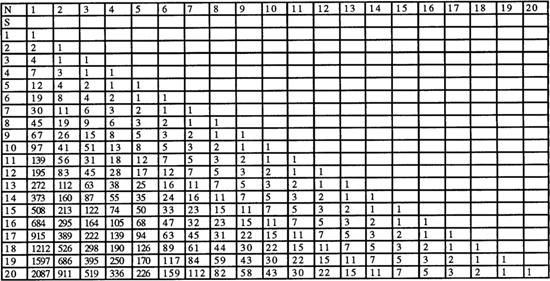
a power law). Actually, there would appear: one sub-summand 5, another 4, two
3, four 2, and twelve 1. See Table 1.
Our exploration of successive
partitions of N (Marijuán et al., 1998), up to N = 50, has shown a large zone
of regularity in the power law distribution for low and middle value of the
summands, but an accompanying tail of exponential law (or exponential cut-off)
for the highest summands. See Figure 1 and Table 1. For example, in the above
partitions of N = 5, the summands 1, 2, 3 and partially 4 would accommodate to
the power law distribution, while 5 itself and partially 4 would be close to the exponential. Understandably, the
exponential cut-off was introducing, in our opinion, an unwanted contamination,
although full of regularity in any case (the graphic representation was showing
an almost crystalline order –Marijuán
et. al., 2001; García-Olivares & Marijuán, forthcoming). See Figure 1 and
Table 1.
|
|
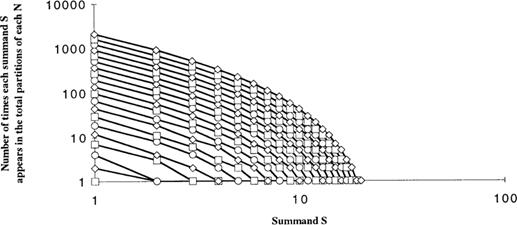 |
Figure 1: Power
laws in partitions. For each number N starting from 1 until 20 there is a curve
that indicates the number of times (in ordinates) that each summand S appears
in the total partitional of the number. The x-axis represents the summand S.
.
Table 1: The same information on N and S than the above curves, now put into the form of a matrix. The first column indicates
values of N (from 1 to 20) and the successive columns indicate the number of
times that appears each summand.
Later on, our accidental discovery
that numerous cases of power law in the literature also contain an ‘unwanted’
exponential cut-off similar to our partitional canon (the term chosen
for the distribution of the total partitional
sub-summands) has suggested
us the possibility of a hidden
order. It is the hypothesis that ‘mature’ distributions of populations of informational
entities might abide to a natural statistics: the partitional canon itself.
Actually, this canon represents the easiest outcome of the easiest operation: a
populational random walk through a landscape of successive minimal additions
and substractions in the structures of the participating agents.
The
suspicion (Gell-Mann, 1994) that an entropy-like distribution related to a deeper phenomenon could underly the natural universe of power laws, has been
interpreted by us in a similar way to the Maxwell-Boltzmann statistics to which
populations of gases do abide. Populations of self-constructing agents (informational
ones) endowed with enough organizational freedom tend to mature, as if pushed
by an invisible hand, towards the partitional canon –a power law with an
exponential cut-off. This is the hypothesis that these authors are going to
check out (Marijuán et al., 1998; García-Olivares & Marijuán, forthcoming).
Partitions, discovered long ago by
mathematician Leonard Euler, nowadays are a hot topic of research. The author
we have already mentioned, Karl Javorsky, has produced a number of intriguing
mathematical structures along his original path of discovery in this new field
(e.g., his System M series of quasi-Fibonacci numbers –Javorszky, 2003).
Besides, Morris Villarroel (2002) has found amazing group structures that
emerge after the application of the three above mentioned principles of
economy, parsimony, and symmetry in a universe of two-dimensional and
three-dimensional communicating messages. Perhaps it is not too farfetched
thinking that a variety of natural (and mathematical) structures and constants
are waiting to be rediscovered along the partitional track. We have also found
that, quite probably, the golden mean shows up in an average operation
related to the power laws with exponential cut-off.
The invisible hand of information is
the great shaper of the natural and social world. Continuous communication
between self-constructing agents leads to an endless variation in their
constitutive structures, involving both production and degradation processes
which stem out from a generative blueprint or from any other form of a slowly
changing ‘identity’. The most common outcome, the preferred signature of the
‘invisible hand’ of information that collectively these agents compose –let us
again state the hypothesis– is the partitional canon.
7
Reductionism
and Information
Claude Shannon was once asked by a
student, “Do you believe that machines can be made to think?” He answered “You
bet. I‘m a machine and so are you.” (supportively quoted by Gell-Mann, 2001, p.
43). Reductionists, which are legion in the natural sciences, miss the most
interesting aspect of life. They are not directly wrong concerning their
mechanistic approach, indeed a useful avenue of analytical research, but they
betray the openness of science when they dogmatically leave out of focus any
emerging aspects unrelated to the successive levels of particulate building
blocks –for instance the inherent evanescence of biological structures and
compounds at every level of organization, that harmoniously integrate the
production and degradation aspects and the communication with the environment.
Here, information (informational) has been considered as the special way of
existence that stems out from such paradoxical ‘evanescent permanence.’
The living being can only be
considered a ‘mechanism’ concerning the teleology of its (evolutionary) design
–but, obviously, that was not the meaning implied by Shannon’s quotation. Of
course, being a material entity, the constitution of the living has to obey the
mechanical ‘forcings’ emanated from its interaction with the boundary
conditions, following natural law (like any other piece of matter). But at the
same time, through the exchange of signals, the living state may alter its own
state (generatively producing a new constitution,
or reconfiguring the present one) so that new boundary conditions will
effectively apply to the interactions with its environment. In this sense, the
living has internal knowledge and may literally choose the landscapes of
natural law which are most favorable for the advancement of its own life cycle. Rather than resorting
to those especial, and rather vacuous, terms coined during the 70’s and 80’s (autopoiesis, autogenesis,
selfproduction, etc.) we can just say that the living existence is informational.
The particulate complex we
have mentioned at the Introduction, so much entrenched within the reductionist way of thinking, actually prevails in
most fields of science and actively
blocks the development of genuine informational
analyses. For instance, atoms (or whatever ultimate particle we
consider) are central explanatory elements not only in physics, and chemistry,
but also in biology (genes as explanatory particles of the living, e.g., Darwin,
Fisher, and sociobiologists), also in neuroscience and behavior (for instance,
conceptualizations such as Pavlovian learning, schemata theory, or the memes),
and in the social, economic and ethical arenas (social atomism, individualism,
and the doctrines of social utilitarism), and not to forget that atomism shines
in linguistics and phonetic analysis too.
Looking for a fundamental explanation
in any of these realms is tantamount as searching for its elementary building
blocks, the “letters” whose combinations form the different levels of structure
in the Galilean book of Nature. As Mcluhan (1962, 1964) and Needham (1962) have
pointed out, the atomistic complex of thought was historically produced by
cultures immersed in the alphabetic system of literacy. (Seemingly, archaic
notions closer to the idea of “balance” and fecundity in nature were superseded
by the new analytic mentality created
by alphabets, perhaps in the shift from matriarchal styles of thinking to
patriarchal ones; see for instance the interesting essay by Ortega y Gaset on
‘Oknos, the rope-maker’). Philosopher Mary Midgley (2001) has poignantly
criticized the atomistic thought which underlies reductionist and specialized
visions of science, while William Abler (1989) has strongly emphasized the
universal importance of the particulate forms of information as the only
viable strategy for the construction of complex systems, either in the natural
or in the artificial.
Of course, advancing the information
science fields would imply far more than criticizing the blind spots of
reductionism in natural science (comments from leading figures in yesteryear’s
‘heterodox’ biological fields such as protein degradation, apoptosis,
development, etc., are really revealing). Such partial blindness actually
impinges into many other branches of our system of knowledge (particularly in
those devoted to ‘complex systems’ where reductionism should be complemented
necessarily by integrationism).
.
We
have socially built an enormous edifice of learning, treated almost as an homogeneous construction
stemming out from the rules for the material but, quite probably, endowed in
most of its disciplinary floors and corridors with the very paradoxical
properties of the informational ‘stuff’ (power laws included). Almost any
aspect of human societies, in spite of misguiding mechanistic terms such as
market forces, social masses, political forces, and so on, belongs to the
informational, per se, we may say.
In the economics proper, there are a
number of organizational items such as money, prices, markets, firms,
management, accounting practices (‘balances’), stock markets, financial
systems, futures, etc., that directly show the imprinting of the informational and bear a sophisticate story
of social design behind
them (Marijuán, 1998; Sánchez Vidal, 2000).
Besides, reflection on the most
recent evolution of economic structures (telecommunications, entertainment,
news, the arts, travel, tourism, fashion, shopping, sports, spectacles...)
indicates an enormous influence by, say, social ‘informational drives.’ Indeed,
a fast growing portion of the economy in the ‘information society’ is devoted
to the massive production and channeling of just ephemeral novelty...
Does this economico-cultural phenomenon of information mass-production relate
to our most ancient past and even to our own nature as species –Homo
informationalis? (Diamond, 1997; Hobart & Schiffman, 1998).
Unfortunately, contemporary neurosciences are far from producing a harmonious
synthetic view on the nature of human ‘information processing’ and its
underlying guidance upon social, cultural and economic evolution. Filling in
this void may be one of the most interesting directions of advancement for the
information science studies.
To conclude these ‘informational’
reflections, at the time being, there might be three paradigmatic directions
for empirically establishing the foundations of information science. They would
extend upon three really strategic scientific territories: cells, brains, and
enterprises (societies). In the extent to which we gain conceptual command upon their common problems
and problem-solving organizations, upon their
differences and similarities, upon their communication and knowledge strategies
–and we develop ad hoc new mathematical tools– a valuable synthesis
would emerge. At the same time, other strategies theoretically inclined have to
explore a variety of further directions. The bet here, just on a personal
basis, is for empirically grounded reflections. Indeed, for the successful
synthesis of a new information science, quite many approaches should
cross-fertilize and add scientific value from very different perspectives.
8
Summary
A tentative new approach to the nature of information
and a critique of the prevailing reductionist views have been presented. The new approach
is mostly based on the molecular organization of the living
cell. It is argued that the
cellular balance between production and degradation of the constituent
structures, performed in continuous communication with the environment and
supported out from a genetic blueprint, may be the paradigm of further
informational existences. Besides, the dynamic balance established by an
informationally guided entity may produce a characteristic mathematical
signature when re-enacted within competing populations of self-producing
agents. The ‘invisible hand’ of information, biologically rooted, and extended both evolutionarily and
socially through more, and more, complex agency realms, becomes the great
shaper of our world.
References
Abler, W.L. (1989) On the particulate principle of self-diversifying systems. Journal of Social and Biological Structures, 12, 1-13. Abraham,
R., Jas, F. & Russell, W. (1995) The Web Empowerment Book. Springer,
New York.
Bak, P. (1996) How
nature works: The science of self-organized criticality. Copernicus: Springer Verlag,
New York. Barham, J. (1996) A
dynamical meaning of information. BioSystems, 38, 235-241.
Castells,
M. (2000) The
Rise of the Network Society.
Blackwell Publ. Ltd., Oxford. 2nd edition.
Conrad, M. (1989) Physics
and Biology: Towards a Unified Model. Applied Mathematics and Computation 32,
75-102. Conrad, M. (1996) Cross-scale information processing in evolution, development and intelligence. BioSystems 38, 97-109. Diamond, J. (1997) Guns, Germs
and Steel: The Fates of Human Societies. W.W. Norton, New York.
Ebeling W. and Frömmel
C., Entropy and predictability of information carriers. BioSystems 46 (1998) pp. 47-55. Fleissner,
P. & Hofkirchner, W. (1998) The making of the information society.
BioSystems, 46, 201-207.
Gasser S.M. (2002)
Visualizing Chromatin Dynamics
in Interphase Nuclei.
Science 296 pp.
1412-1416.
Gell-Mann, M. (1994) The Quark and the Jaguar. Adventures in the Simple and the Complex. Little Brown, London.
Gell-Mann, M. (2001) Consciousness, Reduction, and Emergence: Some Remarks. Annals
of the New York Academy
of Sciences 929, 41-49.
Ho, M.V. (1995)
Bioenergetics. The Open University, London.
Hobart, M.E. & Schiffman, Z.S. (1998) Information Ages. The John Hopkins University Press, Baltimore Hood,
L. & Galas, D. (2003) The digital code of DNA. Nature 421, 444-448.
Igamberviev, A.U. (1997) Quantum
mechanical background of information processing in biological systems
and its relation
to symmetry-breaking. Symmetry: Culture and Science 8, 2, 193-205.
Javorszky, K. (1995)
Zaragoza Lectures on Granularity Algebra,
Mackinger-Verlag, Salzburg.
Javorszky, K. (2000) Interaction Between Sequences and Mixtures, J. of Theoretical Biology, 205, p. 663-665.
Javorszky, K. (2003) Information Processing in Auto-regulated Systems, Entropy,
5, 161-192.
Kay, L.E. (1993)
The Molecular Vision of Life. Oxford University Press, New York.
Kirby K.G., Biological adaptabilities and quantum
entropies. BioSystems 64
(2002) pp. 33-41.
Kitano H., Systems Biology:
Towards System Level.
In Foundations of Systems Biology, ed. by H. Kitano (The MIT Press, Cambridge, 2001)
Lin S.K. (2001) The Nature of the Chemical
Process. 1. Symmetry
Evolution –Revised Information Theory, Similarity Principle and Ugly Symmetry. Int. J. Mol. Sci. 2 pp. 10-39.
Marijuán, P.C. (1994) Enzymes,
automata and artificial cells. In Computing with biological metaphors, ed. by R.C. Paton. Chapman & Hall, London, pp. 50-68.
Marijuán, P.C. (1996)
Gloom in the society of enzymes. BioSystems, 38, 163-171
Marijuán, P.C. (1996b)
Foundations of Information Science. FIS 1994 Conference Proceedings. Biosystems, 38, 87-96.
Marijuán, P.C. (1996c) Information and symmetry in the biological and social realm:
New avenues of inquiry. Symmetry: Culture and Science 7,
3, 281-294.
Marijuán, P.C. (1998)
Information and the unfolding of social life: molecular-biological resonances reaching up to the economy.
Biosystems 46: 145-151.
Marijuán, P.C. (2002)
Bioinformation: untangling the networks of life. BioSystems, 64, 11-118.
Marijuán, P.C. (2003) From Inanimate Molecules to Living Cells:
The Informational Scaffolding of Life. In: Energy and Information
Transfer in Biological Systems. (Ed. Franco Musumeci.) World Scientific
Press, Singapore. In press.
Marijuán, P.C.,
& Villarroel, M. (1998) On Information Theory
Stumbling Blocks. Cybernetics and Human Knowing,
5, 4, 19-29. Marijuán, P.C., Pastor, J. &
Villarroel, M. (1998) The Language of Cells: A Partitional Approach to Cellular
Communication.
Symmetry:
Culture and Science
9, 2-4, 383-392.
McLuhan, M. (1962)
The Gutenberg Galaxy.
University of Toronto
Press, Toronto.
McLuhan, M. (1964) Understanding Media: The Extensions of Man. University of Toronto Press, Toronto.
Midgley, M. (2001) Science and Poetry. Routledge, London.
Needham, J. (1962) Science and Civilization in China. Cambridge University Press, Cambridge. Overbeek, R. (1999) WIT
citation in NetWatch (wit.mcs.anl.gov/WIT2). Science 285, 1323.
Peirce, C.S. (1931-58): Collected Papers vol. I-VIII.
(eds.) Hartshorne and Weiss. Cambridge MA: Harvard University Press. CD-ROM
version from Past Masters.
Rosen, R. (1991) Life itself.
Columbia University Press, New York.
.
Sánchez Vidal,
A. (2000) La máquina del tiempo. In: El Bodegón.
Edited by Fundación Museo del Prado.
Galaxia Gutenberg, Madrid.
Scarrott, G. (1998) The Formulation of a Science
of Information: An Engineering Perspective on the Natural
Properties of Information. Cybernetics
and Human Knowing, 5, 4, 7-17.
Stonier, T. (1990)
Information and the Internal Structure of the Universe. Springer, London.
Villarroel, M. (2002)
Information processing in a partitional framework. FIS 2002 electronic conference.
http://www.mdpi.net/fis2002/browse.htm
Wolfram, S. (2002) A New Kind of Science. Wolfram
Media Inc.
Zuboff, S. (1995) The
Emperor’s New Workplace. Scientific American, September 1995, 162-164.
Zurek, W.H. (1990) Complexity, Entropy,
and the Physics of Information, New York: Addison-Wesley.